
Material You Do Not Own
A toll miller, a cut-make-trim garment unit and a fabricator working client-supplied steel all hold large quantities of material belonging to someone else. There is no field anywhere on inventory that records who owns it — so by default it is all on your balance sheet.
A surprising share of Kenyan manufacturing is done on material the manufacturer does not own. A posho mill takes a farmer's maize, mills it, and hands back flour minus a fee. A garment unit receives fabric and trim from a brand, cuts and makes, and ships finished pieces it never bought. A fabricator quotes labour only, on steel the client delivers. A distributor holds supplier stock on consignment and pays for it when it sells. In every case the material is physically in your store, in your bins, in your counts — and it is somebody else's asset.
This is a data-model question before it is an accounting question, and the data-model answer here is blunt: nothing on any inventory record says who owns the stock. Not the item, not the batch, not the bin, not the warehouse. An asset — a vehicle, a laptop, a machine — carries an ownership type, because the asset register was built knowing that some equipment is leased and some is donor-funded. Inventory was not.
What that means in practice
The consequence is not that anything breaks. It is that everything works, on the wrong number.
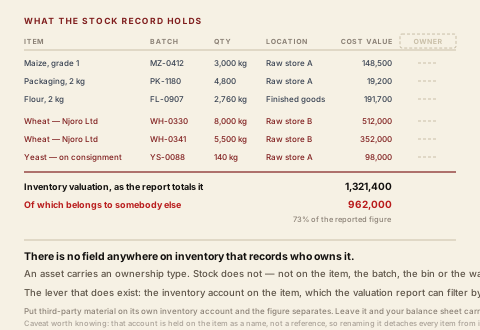
- Inventory valuation includes it. The report totals what is in stock at cost. Customer-owned wheat is in stock, so it is in the total. On a toll operation that can be most of the figure.
- The balance sheet inherits that. Inventory assets is credited and debited by the movements, so third-party material is carried as your asset and — because a receipt credits payables — as your liability too.
- Insurance and finance conversations get harder. A stock figure you have to verbally discount by 70% is not a figure you can hand to a lender or an underwriter.
- Stocktake variances get attributed to you. A count shortfall on client material is a claim against you, not a write-off of your own stock, and nothing in the variance report distinguishes the two.
- And the good news, which is real: batch identity, traceability, quality holds and bin locations all work perfectly well on material you do not own. The physical control is genuinely sound. It is only the valuation that has no way to know.
The physical control over other people's material is good. The financial representation of it does not exist. For a toll processor that is exactly the wrong way round from what the accounts need.
The lever that does exist
There is no owner field, but there is one dimension the valuation report can filter on: the inventory account held on each item. That turns out to be enough to build a workable arrangement, and it is the approach to take rather than waiting for an ownership flag.
-
Create a separate inventory account for third-party stock
Something unambiguous — "Third-Party Stock — Not Owned". It is a new account on your chart, which you can add. The point is that it is a different account from the one your own material sits on, so the two are separable everywhere the account appears.
-
Hold client material as its own items, on that account
Not the same item code as your own equivalent material. "Wheat — customer supplied" is a different item from "Wheat", even though it is the same wheat, because the item is the only place the account can be set. This is the step people resist and it is the one that makes everything else work.
-
Give it its own warehouse or store, too
Stock is held per warehouse and per bin, so a dedicated store for client material keeps it physically separate and makes it obvious to whoever is counting. This does not help the valuation report — that filters by account, not warehouse — but it prevents the far worse operational error of issuing a client's material to your own production.
-
Filter it out at every close
The inventory valuation report takes an inventory account filter and an as-of date. Run it once for your own account and once for the third-party account. The first figure is your inventory; the second is a note to the accounts and a schedule for your client.
-
Add a custom field for the owner's name
Custom fields are available on items, on warehouses and on locations, and can be made required. A field naming the owner on each third-party item gives you the per-client breakdown the account filter alone cannot — which is what you need when three brands' fabric is in the same store.
One fragility to plan around
The inventory account is held on the item as a name, not as a reference to the account record. Rename the account and every item pointing at it is detached — silently, and after the fact. So name it once, name it carefully, and put it on the short list of things nobody edits casually. This is the same class of fragility as the reason on a stock issue, and it bites the same way.
Done properly, this gets you a defensible position with no product changes: separable valuation, separate physical custody, per-owner attribution, and full traceability on material you do not own. What it does not get you is anything automatic. Every one of those five steps is a convention your team has to keep.
Layer by layer, what is actually covered
Holding material you do not own
Knowing where it physically is
Warehouse, bin, quantity, batch and lot identity, with every movement recorded and attributable. As good on client material as on your own.
Traceability and recall on it
A client lot traced forward to what was made from it and who received that, and backwards from a finished batch to its inputs. This is often precisely what a brand client is auditing you for.
Stopping it being used by mistake
Quality holds are enforced by the allocation query itself, and a dedicated warehouse plus distinct item codes make a wrong issue obvious. High-value issues need an elevated permission to approve.
Separating it in valuation
Achievable through a dedicated inventory account and the valuation report's account filter — but only if the items were set up that way from the start. Retrofitting means re-coding items, and historical valuations do not move.
Attributing it to a specific owner
A custom field on the item, requirable. Works, and is entirely a convention you maintain.
An ownership flag on stock
No field on the item, batch, bin or warehouse records who owns it. Assets have an ownership type; inventory has nothing equivalent.
Excluding it from the balance sheet automatically
Movements debit and credit the same inventory and payables accounts regardless of owner. Keeping third-party material off your balance sheet is a manual journal, every period.
A toll-processing or consignment agreement
Nothing models the arrangement: no owner entity holding a stock balance, no processing fee computed from throughput, no statement of material received, processed and returned per client.
A client-facing statement of their stock
The figure exists and is reportable to you. Producing the document a client signs is an export plus a spreadsheet.
Read the pattern rather than the individual rows: physical control is built, financial separation is a convention, and the commercial arrangement is absent entirely. If your toll business is small relative to your own production, the convention is fine. If toll processing is the business, the missing bottom three rows are the business, and you should weigh that honestly.
Which of these situations you are in
If third-party material is occasional
Use the account convention and move on
A separate inventory account, distinct item codes, a dedicated store and an owner custom field. Twenty minutes of setup, one extra line on the valuation at each close, and the exposure is handled. This covers most fabricators and most processors doing occasional toll work.
If toll processing is a real line of business
Set it up properly on day one and budget for manual month-end
The same convention, but treated as a designed part of your chart of accounts rather than a workaround, plus a standing journal each period to lift third-party stock off the balance sheet. Get your accountant to write that journal once and reuse it. Expect the client statement to be a spreadsheet.
If you are a pure contract manufacturer
This is the wrong shape of system for you
A CMT unit or a dedicated toll mill needs an owner as a first-class entity, a stock balance per owner, and a fee computed from throughput. None of those exist and none are a convention you can fake at scale. The inventory, traceability and procurement layers would still serve you well underneath something else — but do not buy this expecting it to model the arrangement.
What AWRA OpsHub does today
- Full physical control on material regardless of owner — warehouse, bin, quantity, batch and lot identity, every movement attributable to a person and a document.
- Traceability in both directions on client lots, which is frequently the thing a brand client audits.
- Quality holds enforced at the allocation, so held stock cannot be issued or sold whoever owns it.
- Separate warehouses and stores, so client material can be physically segregated and counted separately.
- An inventory account per item, and an inventory valuation report that filters by inventory account and by as-of date — which is what makes financial separation achievable.
- Custom fields on items, warehouses and locations, requirable, so an owner name can be captured and enforced.
- Blind cycle counting with valued variance, and transfers between stores with shrinkage recorded.
More we can add to your workspace
- An ownership field anywhere on inventory. Not on the item, the batch, the bin or the warehouse. Assets carry an ownership type; stock carries nothing.
- A consignment model, distinguishing stock you will pay for when it sells from stock you have bought.
- Valuation includes third-party material by default, and the balance sheet inherits that — separating it depends entirely on how you coded the items.
- A warehouse filter on the valuation report. It filters by inventory account and date today, which is why physical segregation alone does not yet give you financial segregation.
- An owner entity and a stock balance per owner, so "how much of Njoro Ltd's wheat do we hold?" is a query against a custom field rather than a balance.
- A processing fee computed from throughput, so the toll charge is an invoice you raise by hand.
- A statement of material received, processed and returned per client.
- Count variances distinguishable by owner, so a shortfall on client material and a write-off of your own stop looking identical in the variance report.
- The inventory account is held on the item as a name, so renaming the account detaches every item from it after the fact.
The single most useful thing on this page is the account convention, because it is available today and it turns an unmanageable exposure into a line on a report. The most important is the last decision option: if holding other people's material is what your business does, the owner entity is a build rather than a convention, and we would rather say so than sell you one that collapses at fifty clients.
Anything above that you need, we can build for you
Everything listed above as something we can add describes what ships in the standard product today — it is a starting point, not a limit on what AWRA OpsHub can do for your organisation. Kenya's eTIMS integration and its maintained payroll engine are both in the product because clients needed them and commissioned them; neither appeared by itself, and the same door is open for whatever you just read about. One qualification so this is worth what it claims: a small number of things on this blog we deliberately leave to a specialist rather than build — a statutory ledger we will not sign our name to, a rule that would decide a tax question for you, a clinical or member-funds record that belongs in a regulated system — and where that is true the post says so in those words. Everything else is a scope, a timeline and a price.
The operational work, which is what most commissions actually are
An extra approval stage in a chain that does not match the standard one, a custom field set on employees or assets that only your sector needs, an expiry that has to block an order rather than send an email, a report your board asks for in a shape nothing produces, or a scanner or weighbridge feeding the goods-in door. These are the commissions we are asked for most often and the smallest ones we quote — and unlike a revenue-authority pipeline, none of them waits on a regulator.
The module-shaped additions, which are the ones readers ask for most often
A price list with real discount authority, a customer-facing quotation that expires, a bill of materials or recipe costing, a staff advance that is issued, acquitted and chased, a member or unit ledger, a matching rule that holds a payment. Each of these is a build rather than a setting, and each has been quoted before — a bigger piece of work than a custom field, with a written spec and a date instead of a roadmap slide.
The report, document or pack nothing currently produces
The board pack in the shape your board actually asks for, a donor or funder layout, an invoice or receipt template carrying what your regulator or your customer expects, a dataset the report builder cannot reach yet. Usually the fastest thing on this list to deliver, because the data is already in the system.
Systems, rails and hardware you already run
The accounting package, CRM, online store, core banking or custom database you intend to keep — connected through our API so a fact is entered once and appears everywhere it is needed. Plus the physical edge: a scanner, a scale, a weighbridge or a till peripheral feeding the door it belongs to.
How it works: you describe the requirement, we return a written scope, timeline and cost, and once agreed it is built into your environment and maintained as part of the product. Nothing here waits on a regulator or a published specification, which is why operational builds are the ones we quote fastest. Tell us the requirement that would otherwise rule us out — that is a better first conversation than a demo.
Tell us what your operation needsOur take
Go and look at your inventory valuation figure and ask what proportion of it you actually own. If the answer is "all of it", nothing here applies to you. If the answer is anything else, that figure has been on your balance sheet and in your management accounts, and the fix — a separate inventory account and distinct item codes — costs an afternoon and is much cheaper before the stock exists than after.
Split the account this week
One new inventory account, distinct item codes for client material, one dedicated store, and an owner custom field. Then run the valuation twice and see what your inventory is really worth.
See inventory management