
Manufacturing in South Africa: Planning Around the Schedule
A published interruption schedule is a planning input, not just a hardship — and the run that gets stopped halfway costs far more than the electricity it did not use. What a stoppage does to the material already issued, and why the discipline this needs is one you run rather than one we ship.
South African manufacturers have one advantage over most of the continent when it comes to power: much of the time, the interruption is announced. That sounds like cold comfort and it is not. A known outage window is a scheduling constraint, and scheduling constraints can be planned around. An unannounced one can only be absorbed.
The manufacturers who handle this well are not the ones with the biggest generators. They are the ones who know, per product, how long a run takes and what an interrupted run costs — and who therefore schedule the things that cannot be stopped into the windows where the power will hold.
That knowledge is not intuition. It comes out of records: a bill of material that reflects what is actually consumed, a way of accounting for value that is mid-process when the line stops, and a yield figure somebody looks at. Two of those three are disciplines rather than features, and one of them we do not hold at all — the honest position is set out below, and it is worth reading before the method.
What an interrupted run actually costs
Ask most production managers what an outage costs and you get an answer about lost output hours. That is the smallest component, and for many processes it is not even the expensive one.
One batch stopped mid-run, costed properly
Illustrative figures indexed to 100 and deliberately generic — the split between these components varies enormously by process, and a cold-fill line and a furnace have almost nothing in common here. The point is that four of the five components are invisible unless work-in-progress is a tracked state. If materials simply leave stock and finished goods eventually appear, all of this lands in an unexplained variance at month-end.
Once you can see that shape for your own products, scheduling stops being guesswork. The batch with a high restart cost gets protected. The batch that can be paused cheaply gets moved into the window. That is a decision worth making weekly, and it is unavailable to anyone whose system only knows raw materials and finished goods.
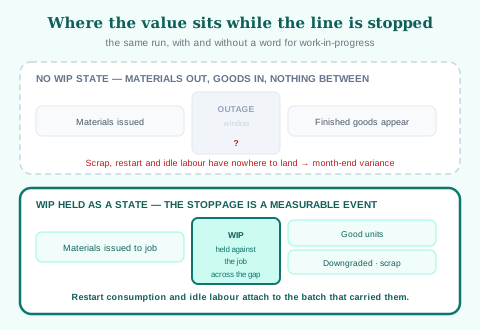
A stoppage does not destroy value silently. It destroys it into an account called variance, which nobody reads because nobody can act on it.
The bill of material is a claim, not a fact
Every manufacturer has a BOM. Far fewer have a BOM that matches what the floor actually consumes, and the gap between the two is where the real margin conversation lives.
The gap is rarely one big error. It is a standard set when the product launched three years ago, a supplier change that altered a moisture content, an operator who found that a little extra reduces rejects, and a scrap rate that everyone has quietly accepted. Each is reasonable. Together they mean your costed BOM describes a product you no longer make.
-
Record issues against the job, not against the day
Material consumed has to attach to the production order it went into. Issuing to a department or a shift makes yield arithmetic impossible from that point onward, and no amount of downstream reporting recovers it.
-
Track work-in-progress as a real state
Between issue and output the value exists somewhere. Giving it a name is what lets a stoppage, a scrap event or a partial completion be recorded rather than absorbed.
-
Book output with quantity and quality
Good units, downgraded units and scrap booked separately at completion. A single "produced" number hides the most useful signal you have.
-
Compare actual to standard, every run
Yield variance per job, reviewed weekly rather than at year end. A drift of a few percent on a fast-moving line is worth more than most cost-cutting exercises and is invisible in a monthly total.
-
Update the standard when reality has moved
A BOM that is permanently wrong in the same direction is not a variance, it is an out-of-date standard. Fix it deliberately, with a date, so the history stays honest.
Questions for a manufacturing demo
Manufacturing modules demo beautifully because the demo data has never been interrupted. Push on the parts that only misbehave in real conditions.
Three things to make them show you
Show me a job that was stopped halfway and resumed the next day.
What the demo shows
A production order being completed cleanly, possibly with a pause button.
What to ask next
Ask where the value sat overnight, what the stock report said at midnight, and what happens if the resumed run consumes more material than the standard. If the honest answer is that the job is either open or closed with nothing in between, work-in-progress is not modelled.
Show me a run that produced good units, downgrades and scrap.
What the demo shows
A completion screen with an output quantity.
What to ask next
Ask whether the three outcomes are separately booked and separately costed. A system that only knows "produced" will let a rising reject rate hide inside a stable output figure for a very long time.
Show me yield variance for one product over the last ten runs.
What the demo shows
A report, or an offer to build one.
What to ask next
An offer to build one is not a no, but it tells you this is not a routine question for their customers. Ask to see it produced live from job records rather than from a spreadsheet somebody maintains.
What we are and are not
This is the post in the South African series where the boundary matters most, because manufacturing software is a category with genuinely deep specialist tools in it and we are not one of them.
What AWRA OpsHub does today
- Material issued to a job, every issue carrying a reason and a person, so actual consumption is recorded as it happens.
- Scrap and by-products recorded against a reason when they occur, and brought onto stock where they have value.
- Raw material and finished goods across locations, with governed transfers, in-transit visibility and recorded shrinkage.
- Batch and lot identity with traceability in both directions, from a supplier lot forward to what was made from it and back again.
- Procurement with enforced approvals and three-way matching into the input side, with landed cost on imported inputs at the rate actually paid.
- Offline capture on the floor, so issues and receipts are recorded during an outage rather than reconstructed after it.
More we can add to your workspace
- A bill of materials: a recipe with a version, an effective date and multi-level explosion, so a finished unit carries a cost assembled from its components rather than its own standing buying price.
- A production order and a work-in-progress state. Material issued to a job is expensed as it leaves the store. It does not sit in a WIP balance between raw materials and finished goods, which is an accounting consequence with its own article.
- A yield and consumption variance. Actual consumption is recorded faithfully today; the standard to compare it against comes with the recipe above, and the variance stops being spreadsheet arithmetic.
- Finite capacity scheduling. We will not sequence your jobs against machine availability or optimise a schedule for you.
- Energy metering. We hold what you paid for power as a cost today; measuring consumption and attributing kilowatt-hours to a run is the build.
- A maintenance planning module — asset records and custody, yes; preventive maintenance scheduling, no.
- A quality management system in the certified sense — we record outcomes, not inspection regimes or certification workflows.
- Turnkey South African statutory payroll, which matters here because shift and overtime costing is often the reason manufacturers ask.
Where we point you to a specialist
- We are not a manufacturing execution system. No shop-floor terminals driving equipment, no machine integration, no PLC or SCADA connection.
Read the first three lines of that second list before anything else on this page, because they are the ones that decide whether the rest is relevant to you. We do the material side of manufacturing — what came in, what it truly cost, where it went, what came out, and who touched it — accurately and attributably. We do not hold the recipe that turns those facts into a variance. If finite scheduling or machine-level execution is your bottleneck, buy an MES and let it talk to whatever holds your stock and your costs. But if the recipe is your bottleneck, no amount of the above closes it, and you should weigh that before you weigh anything else.
What we can build for South Africa on top of the standard product
Everything listed above as something we can add describes what ships in the standard product today — it is a starting point for South Africa, not a limit on what AWRA OpsHub can do there. Kenya's eTIMS integration and its maintained payroll engine are in the product because Kenyan clients needed them and commissioned them; neither appeared by itself. The same door is open here. If SARS-shaped return output, a bank or mobile money feed, a statutory return format, a rule specific to how your operation runs, or a link to a system you already have is what stands between you and a decision, tell us and we will scope it as a build — written spec, timeline and price — before you commit to anything.
SARS output and e-invoicing
VAT201-shaped return output from live records, a maintained rate history rather than a single preset, and e-invoicing against any prescribed interface — with retries, a failure queue and a reconciliation report.
Banks, EFT and card acquirers
Bank statement feeds, EFT and debit-order files, and card acquirer settlement reports pulled into the Payments Register so receipts match invoices without anyone re-keying a statement.
The operational work, which is what most commissions actually are
An extra approval stage in a chain that does not match the standard one, a custom field set on employees or assets that only your sector needs, an expiry that has to block an order rather than send an email, a report your board asks for in a shape nothing produces, or a scanner or weighbridge feeding the goods-in door. These are the commissions we are asked for most often and the smallest ones we quote — and unlike a revenue-authority pipeline, none of them waits on a regulator.
Payroll and statutory returns
EMP201 and EMP501 schedules, UIF declarations and COIDA returns produced in the layout your filing body expects, generated from live payroll records instead of rebuilt each month.
Systems you already run
The accounting package, CRM, online store or custom database you intend to keep — connected through our API so a fact is entered once and appears everywhere it is needed.
How it works: you describe the requirement, we return a written scope, timeline and cost, and once agreed it is built into your environment and maintained as part of the product. No roadmap slide, and no pretending in a demo that something exists when it does not.
Tell us what you need integratedCosting shift work and overtime
A word on the labour side, because it is the question that follows every conversation about interrupted runs. Rescheduling production into evenings and weekends changes your labour cost structure, and the arithmetic of that in South Africa is not a small matter.
| What you need | Where it belongs | Our position |
|---|---|---|
| Hours worked, by person and by shift | Attendance capture | Held in AWRA, including offline capture where the floor has no reliable connection |
| Labour cost allocated to a job or cost centre | Cost allocation | Held in AWRA, so a job can carry its labour as well as its materials — note it is a job, not a production order |
| Overtime and shift premium calculation to statutory rules | Payroll | Not ours. Rules must be configured to your practitioner's specification, and they are yours to keep current |
| PAYE, UIF, SDL and statutory submissions | Payroll | Not ours at all — see the payroll post. Our maintained statutory engine covers Kenya only |
The full reasoning on that boundary, including why we recommend a specialist, is in payroll, PAYE, UIF and SDL in South Africa.
Where to go next
If moving goods rather than making them is your pressure, inventory for South African distributors and retail covers the in-transit window and long inland legs. The costing of imported inputs sits in SARS, VAT and rand operations, and the overall purchase decision — including whether to replace your finance system at all — in the South Africa buyer's guide.
Our take
Model work-in-progress before you model anything clever. Once the value between issue and output has a name, an interrupted run becomes a measurable event rather than a month-end variance, and the scheduling decision — what to protect, what to move — becomes a calculation instead of an argument. Buy an MES if execution is your bottleneck; buy materials discipline if, as is more common, the bottleneck is that nobody knows what a batch really consumed.
Bring the run that went wrong
Bring one interrupted run and the material that was already issued to it. We will show you what the system records about where that value went and who touched it — and where the recipe would have gone, if we held one. The second half of that answer is the honest part.
Explore AWRA for South AfricaFrequently asked questions
Is AWRA OpsHub a manufacturing execution system?
No, and it is worth being blunt about that. There are no shop-floor terminals driving equipment, no machine or PLC integration, no finite capacity scheduling and no energy metering. What we provide is the materials layer around production: material issued to a job with a reason and a person, output brought onto stock, batch identity and traceability in both directions, and landed cost on imported inputs. Two things people expect in this list are absent — there is no bill of materials and no yield variance against standard, because there is no standard to vary from. Work in progress does now exist for material: an issue charged to a job is held as an asset until output is received against that job. If machine-level execution or finite scheduling is your bottleneck, buy an MES and let it feed whatever holds your stock and your costs. If the recipe is your bottleneck, we are not the answer yet.
How does it handle a run that is interrupted by an outage?
Material issued to the job stays attributed to that job, and further consumption after the restart is recorded against it too, so scrap and restart material attach to the work that carried them rather than vanishing into a month-end total. That material is also held in a work-in-progress balance for the job rather than expensed on the way out, so a run stopped halfway through is worth what was issued to it and shows on the balance sheet as such. Be clear about the limit: when output is finally received it is valued at the finished item's standing price, not at what the run consumed, so the job rarely clears to exactly zero — and the difference is a residual you read and explain rather than a variance the system computes for you.
Can it schedule production around known interruption windows?
Not automatically — we do not sequence jobs or optimise a schedule against machine availability. What the system gives you is the information the scheduling decision needs: how long each product's run takes in practice, and what an interrupted run of that product has historically cost. Manufacturers who plan well around outages are usually making that call from job history rather than from an optimiser.
Will it show us where our bill of material is wrong?
Not on its own, because it does not hold your bill of material and so has nothing to compare against. What it will give you is the honest half of that comparison: actual consumption per job and per product, recorded at the time with a reason and a person, which is the number most manufacturers do not really have. Put it beside your standard in a spreadsheet and persistent variance in the same direction is the signal your standard has drifted — a supplier change, an operator adjustment, an accepted scrap rate. The system makes the actual figure trustworthy and weekly. Turning it into a variance is still your arithmetic.
Does it cost imported raw materials properly?
Yes. Foreign-currency purchases record the exchange rate actually paid, and landed cost folds duty, freight, clearing and inland transport into the true unit cost of the input. That gives you a trustworthy cost for the input itself, which is the part most often wrong. What it does not do is flow onward into an assembled finished-goods cost, because there is no bill of material for it to flow through — the finished unit carries its own standing price. So the input cost is honest and the roll-up to a unit cost is yours to do.
What about shift work, overtime and payroll?
Attendance and hours are captured in AWRA, including offline on the floor, and labour cost can be allocated to a job or cost centre so a production order carries its labour alongside its materials. The statutory calculation is not ours: PAYE, UIF and SDL are not automated, overtime and shift premium rules must be configured to your practitioner's specification, and nothing is submitted or remitted on your behalf. Our maintained statutory payroll engine covers Kenya only.
