
Manufacturing Operations in Nigeria: The Real Cost of Power
Nigerian manufacturers carry a cost their bill of materials rarely admits to: the price of making power, and the price of an input bought at a rate that has since moved. What it takes to know the true cost of a unit before you price it.
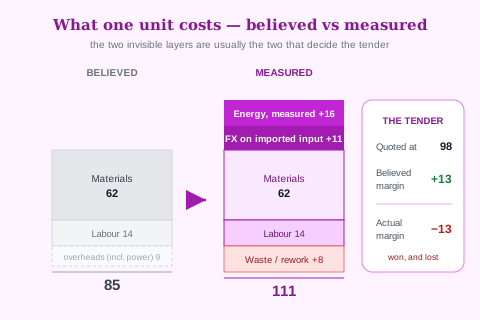
Ask a Nigerian manufacturer what a unit costs to make and you will usually get a confident answer. Ask how the figure was arrived at and the confidence tends to thin out around the third question. The materials are known. The labour is roughly known. Energy is a monthly bill that lands somewhere in overheads. Waste is an assumption inherited from whoever ran the line before. And the imported input was costed at a rate somebody used two months ago.
None of that is negligence — it is what happens when the cost of a unit is calculated once, annually, and then defended. The trouble is that in Nigeria at least two of those components move continuously, so a unit cost that was accurate in January is fiction by June, and every pricing and tender decision made from it inherits the error.
The bill of materials is the honest starting point
A bill of materials states what goes into one finished unit — quantities, not guesses. Most small and mid-sized manufacturers have one in someone's head and a different one in the spreadsheet used for quoting, and the gap between them is where margin disappears.
Writing it down properly does two things immediately. It makes consumption predictable, so you can compare what production should have used against what the store actually issued. And it turns waste from a vague assumption into a measured number — the yield variance — which is usually the first genuinely surprising figure a manufacturer sees after digitizing. The mechanics are in raw material yield control, and the surprise is nearly always in the same direction.
You cannot manage a waste rate you have never measured. Most manufacturers do not have a waste problem — they have a waste-visibility problem, and the two feel identical from the office.
What the standard cost model leaves out here
Textbook unit costing assumes stable input prices and utility power. A Nigerian plant operates with neither, so two line items that sit quietly in overheads elsewhere need to be pulled into the light.
| Cost component | How it is usually treated | What it should be |
|---|---|---|
| Raw materials | Standard cost from the last price list | Actual cost of the batch consumed, including landed cost on imports |
| Imported inputs | Invoice value converted at a convenient rate | The rate actually paid on that consignment, plus duty, freight and clearing |
| Energy | A monthly bill absorbed into overheads | A cost per production hour or per unit — diesel and grid, measured, not assumed |
| Waste and rework | An inherited percentage nobody has re-tested | A measured yield variance per run, per line, per shift |
| Labour | Headcount divided by output | Hours attributable to a production run, including rework hours |
The energy line deserves particular attention because it behaves unlike any other overhead. It is not fixed, it is not proportional to output in a simple way, and it varies with something entirely outside your control — how much grid supply you got this week. A plant that ran mostly on diesel in one month and mostly on grid in the next has two genuinely different unit costs, and averaging them across a quarter hides exactly the variance a manager needs to see.
Imported inputs and a moving rate
If any part of your input mix is imported, your unit cost has a currency exposure built into it whether or not you account for one. The discipline is the same as for any importer: record the rate actually paid against the transaction, and fold duty, freight, clearing and handling into the cost of the material that arrived — landed cost, applied to raw materials rather than finished goods.
The manufacturing-specific consequence is that two batches of the same material can legitimately carry different costs, and the finished units made from them are genuinely not equally profitable. Which costing method you use to resolve that — FIFO or weighted average — is a real decision with real consequences for reported margin, not an accounting formality. Weighted average smooths the volatility and hides it; FIFO shows it and makes people uncomfortable. In a volatile-input environment there is a reasonable argument for discomfort.
The production cycle, controlled
-
Issue materials against a production run, not to "the factory"
Every issue booked to a specific run with a quantity and a person. Until this is true, consumption cannot be compared to the BOM and yield is unmeasurable.
-
Record output against the same run
Good units, rejected units and rework, all attributed. The gap between BOM-expected consumption and actual is your yield variance — the number most worth watching daily.
-
Hold what fails quality, structurally
A quality hold that removes stock from sellable inventory rather than a note on a clipboard. Quality holds and traceability covers why a hold that can be ignored is not a hold.
-
Attach energy and labour to the run
Production hours, and the fuel or grid consumption over those hours. Coarse is fine — a defensible allocation per run beats a precise figure per quarter that tells you nothing.
-
Close the run and compare to standard
Expected cost versus actual cost, every run. Variances investigated while the shift is still reachable, not summarised at month-end when they are only history.
-
Feed real costs back into pricing
The point of the whole exercise. A quote built on last quarter's standard cost in a market where inputs and power both moved is a quote built on a number you have already disproved.
Start with one product line
Manufacturers who attempt to model every SKU at once produce an elaborate configuration nobody maintains. Pick the line with the highest volume or the thinnest margin, get its BOM, issues, output and yield genuinely accurate for a month, and let the result make the case for the second line. One trustworthy line beats twelve theoretical ones.
What we do and do not do for manufacturers
What AWRA OpsHub does today
- Material issues booked to a job, with a reason and a person on each one, and finished output brought onto stock.
- Waste and scrap recorded against a reason at the moment it happens, with high-value issues held for approval.
- Landed cost on imported inputs, with the exchange rate recorded against the purchase.
- Quality holds that structurally remove stock from sellable inventory, plus batch traceability.
- Asset registers for plant, generators and equipment, with named custody, movement history and condition on every hand-off. Service schedules are not part of the register.
More we can add to your workspace
- A bill of materials: a recipe with a version and an expected consumption per unit, so something holds what a finished unit should have consumed.
- A yield and waste variance. Actual consumption is recorded properly today; the standard to compare it against comes with the recipe above, and the variance stops being spreadsheet arithmetic.
- A production order. Material issued to a job is held in a work-in-progress account until output is received back against that job, so an interrupted run already carries a balance; what the order object adds is a unit of work above the job, and a home for an issue raised without a job on it.
- Metered energy. Fuel and power read from a sensor and costed automatically, rather than captured as a cost by a person.
- FIRS e-invoicing — our fiscal integration is Kenya's eTIMS and it is Kenya-only.
- Turnkey Nigerian statutory payroll — today factory payroll runs on your existing process or on manual configuration.
Where we point you to a specialist
- We are not an MES or shop-floor scheduling system. No machine-level scheduling, no capacity planning, no real-time line telemetry.
If you need machine-level scheduling or automated energy metering, you need a specialist system alongside this one — and you should be told that before you buy, not after. Confirm any tax or statutory obligation with FIRS or your adviser.
What we can build for Nigeria on top of the standard product
Everything listed above as something we can add describes what ships in the standard product today — it is a starting point for Nigeria, not a limit on what AWRA OpsHub can do there. Kenya's eTIMS integration and its maintained payroll engine are in the product because Kenyan clients needed them and commissioned them; neither appeared by itself. The same door is open here. If FIRS e-invoicing, a bank or mobile money feed, a statutory return format, a rule specific to how your operation runs, or a link to a system you already have is what stands between you and a decision, tell us and we will scope it as a build — written spec, timeline and price — before you commit to anything.
FIRS e-invoicing and tax pipelines
Invoice transmission against the authority's published interface, plus WHT credit handling and sector levies — with the parts vendors gloss over: retries, a failure queue and a daily report of sales carrying no fiscal reference.
Banks, cards and transfers
Bank statement feeds, card acquirer settlements and bulk-payment files pulled into the Payments Register, so money in and out reconciles without anyone re-keying a statement.
The operational work, which is what most commissions actually are
An extra approval stage in a chain that does not match the standard one, a custom field set on employees or assets that only your sector needs, an expiry that has to block an order rather than send an email, a report your board asks for in a shape nothing produces, or a scanner or weighbridge feeding the goods-in door. These are the commissions we are asked for most often and the smallest ones we quote — and unlike a revenue-authority pipeline, none of them waits on a regulator.
Payroll and statutory returns
PAYE, pension and NHF schedules produced in the layout your filing body expects, generated from live payroll records rather than rebuilt in a spreadsheet each month.
Systems you already run
The accounting package, CRM, online store or custom database you intend to keep — connected through our API so a fact is entered once and appears everywhere it is needed.
How it works: you describe the requirement, we return a written scope, timeline and cost, and once agreed it is built into your environment and maintained as part of the product. No roadmap slide, and no pretending in a demo that something exists when it does not.
Tell us what you need integratedThe payoff is pricing you can defend
Everything above converges on a single capability: quoting a price knowing what the unit actually costs this month, with this input mix, at this power situation. That is the difference between winning a tender and winning a profitable tender, and in a market where competitors are quoting off stale standard costs it is a genuine advantage rather than a hygiene factor.
It also changes what you notice. A yield variance that appears on one shift and not another is a training question. Energy cost per unit that jumps in a month of poor grid supply is a capital-investment question. An input whose landed cost has drifted 20% is a sourcing question. None of those questions can even be asked from a single annual costing exercise.
If you are still selecting a system, the evaluation rubric and the honest position on FIRS and Nigerian payroll are in our Nigeria ERP buyer's guide. If your imported input exposure is the dominant problem, procurement and landed cost discipline is where the control actually lives.
Our take
Build the BOM, book issues to runs, and pull energy and FX out of overheads into the unit cost where they belong. Do that for one product line and you will find at least one number you were confidently wrong about — most manufacturers do, and it is usually waste or power. Everything else in a manufacturing system is refinement on top of those four moves.
See what a unit actually costs you
Material issues booked to jobs with a reason and a person, landed cost on imported inputs at the rate you actually paid, and quality holds that actually hold. The recipe and the yield variance are not built — see the honest position above.
Explore AWRA for NigeriaFrequently asked questions
Is this a full manufacturing execution system?
No, and it is worth being clear about that before you evaluate it. There is no machine-level scheduling, capacity planning or real-time line telemetry. What it does is the materials side of manufacturing: issues booked to a job with a reason and a person, output brought onto stock, landed cost on imported inputs, quality holds and asset registers. What it does not do is hold the recipe those issues should be measured against, so there is no yield variance — that comparison stays on your spreadsheet, fed by consumption figures the system does record accurately. If you need shop-floor scheduling as well, you need a specialist system alongside.
How do we account for diesel and generator costs per unit?
By capturing fuel and power consumption against production hours and allocating it to runs, rather than letting it sit in monthly overheads. The allocation does not need to be sophisticated to be useful — a defensible cost per production hour tells you far more than a precise quarterly figure that averages a diesel-heavy month with a grid-heavy one. The value is in seeing the variance between months, which is exactly what averaging destroys.
Can it handle imported raw materials bought in foreign currency?
Yes. The purchase records the exchange rate actually applied, and landed cost folds duty, freight, clearing and handling into the cost of the material received. That means two batches of the same input can carry different costs — which is accurate, not a defect — and your finished goods inherit the real cost of the batch they consumed rather than a standard price that expired.
What is the first thing to implement?
Material issues booked to a specific job rather than to the factory generally, for a single product line. That is the half the system does, and it is the half that has to be true before anything else means anything. The bill of materials for that line is the other half and it lives in your spreadsheet, because the system does not hold one — put the two side by side and the yield variance is the first genuinely surprising number most manufacturers see. Attempting to model every SKU at once produces a configuration nobody maintains past the second month.
Does it track plant and equipment maintenance?
It tracks the asset, not the maintenance. You get a register with named custody, movement history and condition recorded on every hand-off for plant, generators and equipment, so you know what you have, who holds it and where it has been. What it does not hold is the upkeep: there is no service interval, no next-service-due date, no reminder, and no way to log that a service or repair took place against the machine. So treat this as the register and custody layer, keep the maintenance calendar wherever you keep it now, and do not expect a computerised maintenance management system with condition monitoring or predictive scheduling.
