ERP Software in the UAE: A Practical Buyer's Guide (2026)
The UAE has more competent implementers per square kilometre than anywhere else in this corpus, so "who can do it" is the wrong opening question. The right one is which of three quite separate products you are actually shopping for — and where an international vendor should honestly lose.
Most buyer's guides in this corpus were written for markets where the hard problem is finding anyone competent. The UAE is the opposite case. There is no shortage of capable partners here for every tier of product, which removes the usual bottleneck and exposes a different one: buyers routinely go to market for three different things at once, describe all of them as "the ERP", and then cannot understand why the proposals are incomparable.
We sell into this market and we are going to argue for ourselves in one specific case and against ourselves in several others. That is not modesty. It is that the cases where we are wrong for a UAE business are unusually easy to identify in advance, and finding out in month three is expensive for both of us.
None of this is tax, customs or legal advice. Confirm your VAT position, your corporate tax position and your e-invoicing obligation with the Federal Tax Authority, the Ministry of Finance or your adviser.
Three products, one word
Separate these before you write a requirements document and the shortlist mostly writes itself. Leave them fused and you will end up comparing a compliance suite against an operations platform on price.
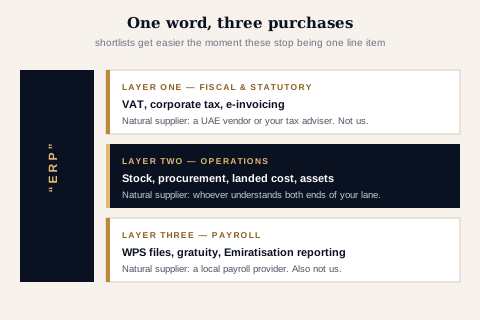
Layer one
Fiscal and statutory
VAT records and returns, corporate tax computation, and e-invoicing under the Ministry of Finance programme once your phase applies. Natural supplier: a UAE product or your tax adviser. This is where a local vendor has an advantage that no amount of international product quality overcomes, and where we are not a candidate at all.
Layer two
Operations
Stock across locations, procurement with approvals that block, landed cost per consignment, assets, evidence attached to transactions. Natural supplier: whoever understands your actual operation. This is the layer we sell, and the only one on which we would ask you to compare us against anybody.
Layer three
Payroll and wage protection
WPS salary files for MoHRE or your free zone authority, end-of-service gratuity, Emiratisation reporting. Natural supplier: a local payroll provider or an exchange house arrangement. Almost every business here already has this solved and should not disturb it to satisfy a software diagram.
The common mistake is assuming layer one must dictate layers two and three. It does not. A two- or three-vendor arrangement is entirely normal here and is stable provided each shared fact has exactly one owner, agreed in writing before go-live. The arrangement that fails is the undeclared one, where two systems both believe they own invoice numbering.
"Localized for the UAE" — which layer do they mean?
Every vendor on your list will say yes to that question, ourselves included, and every one of them will mean something different by it. Below is our own answer, layer by layer, with nothing rounded up. Ask each vendor to produce the same table and compare those rather than the brochures.
AWRA OpsHub in the UAE, layer by layer
Currency
The dirham ships as a base currency preset. Foreign-currency purchases are held in their own currency at the rate actually applied to that transaction, which matters more here than the peg does.
Stock, procurement and landed cost
Locations, governed transfers with documents attached, three-way matching with discrepancies flagged, a purchase order that cannot be closed until the goods are received, and duty and clearing allocated per consignment into true unit cost. This is the layer we are actually selling. What it does not include is a value ceiling on a purchase order — the hard threshold in this product is on stock write-offs.
VAT rate
A 5% preset ships built in and every line separates net, tax and gross at capture. We ship one preset rather than a maintained rate history, and additional tax lines are yours to configure and keep current.
Working week and public holidays
Non-working days and holidays are set per organization, and leave arithmetic, workflow due dates and escalation, and helpdesk response clocks all read that setting. Necessary here, because the weekend is not uniform across emirates or sectors.
FTA e-invoicing
No connection to the Federal Tax Authority or any accredited service provider. Nothing structured, submitted, cleared or retrieved. Our only fiscal e-invoicing integration anywhere is Kenya's eTIMS and it does not travel.
Corporate tax
No computation of the 9% charge, no small business relief test, no free zone qualifying-income assessment, and no statutory accounts. We hold the record it is computed from; your adviser does the computation.
Payroll and WPS
No wage protection file for MoHRE or a free zone authority, no gratuity accrual to UAE rules, no Emiratisation reporting. Our maintained statutory payroll engine covers Kenya only. Employee records, leave, attendance and payroll cost allocation work anywhere.
Arabic interface
English only, no right-to-left layout, documents in English. This bites less in Dubai than in Cairo because the commercial floor already runs in English — but "less" is not "never", and it is your call rather than ours.
What to weight, and what to stop weighting
Shortlist scoring in this market tends to over-reward demo polish and under-reward two or three questions that decide the whole implementation. A rough weighting we would defend.
Weighting a UAE shortlist
Score each vendor out of five on the test in the right-hand column, not on the answer they give the criterion.
Handles the free zone / mainland cost split
Make them prove it: Ask them to model one consignment twice — re-exported and cleared — and show two unit costs with the reason they differ. Most products can be made to do this; many implementations never are.
Who owns the fiscal layer, in writing
Make them prove it: Ask for a one-page boundary document naming the owner of customers, items, prices, stock and invoice numbering. A vendor who cannot produce one in a week has not thought about it.
Language on the floor, not in the boardroom
Make them prove it: Put the receiving screen in front of the person who will actually key receipts. Their reaction is the answer; the finance director's is not.
Depth at the far end of your trade lane
Make them prove it: If you feed operating companies elsewhere, ask what the product does after the container leaves. Most Dubai-sold systems stop at an export document and a customer balance.
What your own team can change unaided
Make them prove it: Ask them to change an approval threshold and add a report field live, in the demo, without a consultant. This predicts your year-two cost better than any line on the quote.
Demo polish and module count
Make them prove it: Deliberately low. Every serious product in this market demos well, and module count correlates with implementation length rather than with value.
Questions worth asking us specifically
Four questions where our honest answer may end the conversation
Are you compliant with UAE e-invoicing?
What most vendors say
Yes, we are fully compliant and ready for the mandate.
What we say
No. There is no FTA integration and no accredited service provider connection. If your phase applies and you need it on day one, buy from a UAE vendor or pair us with a compliance product — and press whoever supplies it on rejection handling, because a silently rejected document is the failure that actually occurs.
Do you support Arabic?
What most vendors say
Yes, the interface is available in Arabic.
What we say
No. English only, no right-to-left layout, documents in English. In practice most UAE commercial and warehouse floors already operate in English, so this is frequently a non-issue here in a way it is not in Cairo — but test it with your own staff rather than accepting our generalisation about your business.
Can you handle our free zone and mainland entities?
What most vendors say
Yes, unlimited companies with full consolidation.
What we say
Two shapes, both real. Two organizations for clean legal separation and no automatic group view, or one organization with the two as separate locations for a single operational picture and costed transfers between them. What we do not offer either way is intercompany elimination or a statutory consolidation. Decide which shape you want before go-live.
Why would we buy from Nairobi?
What most vendors say
We are a global company with local presence.
What we say
For one reason: your operation has an African leg and we are unusually good at that end. If your business is entirely inside the UAE, a local implementer is the better purchase and we will say so on the first call. We would rather lose the deal in week one than in month six.
Our scope, in one place
What AWRA OpsHub does today
- Dirham base currency and a 5% VAT preset, with net, tax and gross separated on every purchase and sales line at capture.
- Stock across free zone and mainland locations with governed, costed transfers and the customs paperwork attached to the transfer.
- Landed cost per consignment — freight, insurance, handling, duty and clearing carried into true unit cost.
- Procurement with RFQ comparison and three-way matching, and a purchase order that cannot be closed before goods are received. There is no value ceiling on a purchase order, no field recording why a quotation was chosen, and document-expiry reminders cover employee and contract documents rather than supplier ones. Stock write-offs do refuse above a threshold you set, and cannot be approved by whoever raised them.
- Assets with named custody, verification schedules and entity or project attribution held on the record.
- The African leg in real depth — clearing, branch and van stock, mobile money collection, offline capture.
More we can add to your workspace
- A FTA e-invoicing integration and no accredited service provider connection.
- A UAE corporate tax computation and no statutory financial statements.
- A WPS salary file, gratuity accrual or Emiratisation reporting. The maintained statutory payroll engine covers Kenya only.
- An Arabic interface and a right-to-left layout.
- A customs system integration — Dubai Trade, Mirsal or port community system.
- An intercompany elimination or consolidated statutory accounts.
Six items in each column is not a coincidence of drafting. If the right-hand column contains anything you need on day one, the correct decision is a UAE vendor, and we would rather you reached it from this page than from a proposal review. If it does not, the left-hand column is a genuinely strong operations layer and worth an hour of your time.
What we can build for the UAE on top of the standard product
Everything listed above as something we can add describes what ships in the standard product today — it is a starting point for the UAE, not a limit on what AWRA OpsHub can do there. Kenya's eTIMS integration and its maintained payroll engine are in the product because Kenyan clients needed them and commissioned them; neither appeared by itself. The same door is open here. If FTA e-invoicing, a WPS salary file, a bank or mobile money feed, a statutory return format, a rule specific to how your operation runs, or a link to a system you already have is what stands between you and a decision, tell us and we will scope it as a build — written spec, timeline and price — before you commit to anything.
FTA e-invoicing and VAT output
Document structuring and submission through an accredited service provider under the Ministry of Finance programme, with the parts vendors gloss over — rejection handling, resubmission, and a daily report of sales carrying no registration identifier. Corporate tax computation stays with your adviser by design; what we would build is the record it is computed from.
Banks, acquirers and customs paperwork
Bank statement feeds, card acquirer settlements and instant-payment files pulled into the Payments Register, plus a data link to your clearing agent or port community system so a customs event updates the consignment instead of arriving as an email.
The operational work, which is what most commissions actually are
An extra approval stage in a chain that does not match the standard one, a custom field set on employees or assets that only your sector needs, an expiry that has to block an order rather than send an email, a report your board asks for in a shape nothing produces, or a scanner or weighbridge feeding the goods-in door. These are the commissions we are asked for most often and the smallest ones we quote — and unlike a revenue-authority pipeline, none of them waits on a regulator.
Payroll and statutory returns
WPS salary files in the layout MoHRE or your free zone authority expects, with end-of-service gratuity accrued on live employee records rather than estimated in a spreadsheet each year.
Systems you already run
The accounting package, CRM, online store or custom database you intend to keep — connected through our API so a fact is entered once and appears everywhere it is needed.
How it works: you describe the requirement, we return a written scope, timeline and cost, and once agreed it is built into your environment and maintained as part of the product. No roadmap slide, and no pretending in a demo that something exists when it does not.
Tell us what you need integratedWhen to buy locally, plainly
- If FTA e-invoicing is required for you now, and you want one accountable vendor for it, buy a UAE product. This is the single most common correct answer on this page.
- If your staff work in Arabic, buy locally regardless of anything else here.
- If you want corporate tax computed inside the system, we do not do it and will not pretend otherwise.
- If you need on-site presence as a first criterion, Dubai has plenty of it and we have none.
- We are worth a conversation when the fiscal layer is already settled, your team works in English, and your real cost is stock, landed cost and visibility — particularly across a lane into Africa.
Where to go next
The cost arithmetic behind the free zone question is worked through properly in one SKU, two landed costs. If your Dubai entity feeds operating companies further south, the Dubai–Africa trade lane is the case we actually make here. And for how a clearance-style fiscal regime reshapes a system architecture — written for another market, but the structural argument transfers — see ETA e-invoicing and your operations system.
Our take
Split the word "ERP" into its three products, settle the fiscal layer first and separately, then shop for the operations layer on the two or three questions that actually predict an implementation — the cost split, the written boundary, and what your own team can change without a consultant. Do that and this market's depth of supply becomes an advantage instead of a fog. Most UAE businesses following that process will buy locally, and should. A minority with a real African leg should call us.
The short version of the call
Tell us your fiscal arrangement, your working language and whether you have an operating company outside the UAE. Those three answers usually settle whether there is anything worth discussing, and the call is short either way.
Explore AWRA for the UAEFrequently asked questions
Is AWRA OpsHub an ERP?
It is an operations platform with real accounting underneath, which covers most of what people mean by ERP in a trading or distribution business — stock, procurement, sales, assets, projects, HR records and a general ledger. What it is not, in the UAE specifically, is a fiscal or statutory product: no FTA e-invoicing, no corporate tax computation, no UAE statutory accounts and no WPS payroll. If your definition of ERP includes those, we are a component rather than the answer, and the honest framing is a two-vendor arrangement.
Do we have to choose between a local vendor and you?
Not necessarily, and pairing is common. A compliance product owns document issuance and registration; we own stock, procurement, cost, assets and evidence. That works well provided the boundary is written down before go-live — one named owner for customers, items, prices, stock position and invoice numbering, visible to both vendors. Where it goes wrong is when nobody draws it and both systems quietly assume they are authoritative.
How does pricing compare with local products?
We are generally positioned below a tier-one international suite and in the same territory as a serious mid-market product, and the number worth comparing is not the licence but the implementation and the second year. Ask every vendor on your list what changing an approval threshold or adding a report field costs after go-live, because in this market that figure varies by an order of magnitude and it is where budgets actually go. Current pricing is on our plans page.
What does implementation look like from Nairobi?
Remote, in English, as guided sessions on your own data rather than a classroom. Dubai is one hour ahead of us so the working days overlap almost completely. Typical sequence: configure locations, roles and approval permissions, suppliers and opening stock; run one real cycle end to end — a purchase approved, received, costed, matched and paid — then extend. If on-site presence during go-live is a firm requirement, that is a legitimate reason to buy locally and we will say so early.
Can you support a group with entities in the UAE and in Africa?
That is the case we are built for, and it is the reason this page exists. Each entity runs with its own base currency, users and approvals, and the group view is a reporting layer across them. What does not travel between countries is fiscal integration and statutory payroll automation — those are Kenya-only today — so every other entity runs on the general operations, multi-currency and VAT-aware layer with its local compliance handled locally. Be clear that a group view is reporting, not a statutory consolidation.
A lot of our customers pay us by post-dated cheque. Does that work?
Not today, and this is the most likely reason for a UAE business to find us unsuitable, so it belongs in this list rather than in a later conversation. There is no cheque instrument in our schema in either direction — no cheque number, no cheque date, no drawee bank and no clearing state — so a receivable settled by paper dated six weeks out can only be recorded as outstanding or as paid, and both are wrong. Marking it paid invents cash you do not hold; leaving it outstanding chases a customer who considers themselves settled. [A Cheque We Only Understand Going Out](/blog/a-cheque-we-only-understand-going-out) sets out the whole gap, including why adding a cheque-number field to an invoice would not close it. If post-dated cheques are a meaningful share of your collections, weigh that before anything else on this page.
What happens when the e-invoicing mandate reaches us?
Two honest routes. Either your compliance vendor handles issuance and registration and we hold the operations record alongside, storing whatever identifier comes back on our transaction — which is the arrangement we would recommend and the one that makes a daily unregistered-sales report possible — or you commission the integration from us as a scoped build with a written spec, timeline and price, the way Kenya's eTIMS integration came to exist. What we will not do is tell you it is on a roadmap and let you buy on that basis.