HR Software in Kenya: What a Growing Employer Actually Needs
Most Kenyan employers do not have an HR problem — they have an HR records problem that only becomes visible on payroll day. What a growing employer actually needs, in the order it starts to hurt, and the straight answer on what is automated and what is not.
There is a size at which an employer stops being able to hold the workforce in their head, and it is smaller than most people expect. Somewhere around fifteen or twenty staff, the questions start arriving faster than memory can answer them: how much leave does she have left, was his contract renewed, why is this month's NSSF different, who authorised that allowance, and what exactly did we pay this person last March?
None of those are hard questions. They are only hard to answer twice the same way, which is a records problem wearing an HR costume. And in Kenya it carries a statutory edge that most operational problems do not — PAYE, NSSF, SHIF and the housing levy are computed on records, and a wrong record produces a wrong deduction that is somebody else's money.
The order things start to hurt
Employers rarely need all of HR at once. They need it in a fairly predictable sequence, and buying out of sequence is how HR software ends up unused.
-
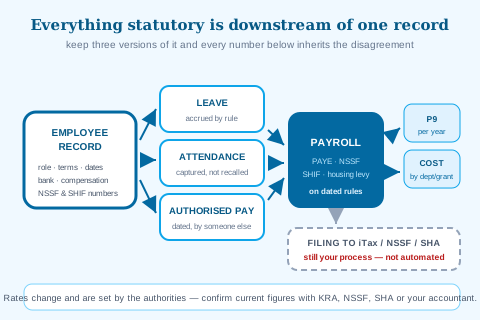
One employee record
Who works here, in what role, on what terms, since when, with what statutory numbers. Not an HR list, a payroll sheet and a bank mandate file that disagree — one record everything else reads from.
-
Leave, because it is the first thing disputed
Balances that accrue by rule rather than by someone's arithmetic, and requests approved on the record. Leave is where employees first notice whether your HR is real.
-
Attendance, once pay depends on presence
The moment overtime, shifts or casual days affect pay, attendance stops being a register and becomes a payroll input. It has to be captured, not remembered.
-
Payroll, once the statutory load is real
PAYE, NSSF, SHIF and housing levy computed from the records above — not re-keyed from a spreadsheet whose formulas nobody has re-checked since the last rate change.
-
Cost allocation, once anyone asks what a department costs
Payroll split by department, project or grant and posted into the same ledger as every other outflow, so management reporting is complete.
Notice that payroll is fourth, not first. Employers who buy payroll before employee records and attendance end up with a fast calculator fed by the same unreliable inputs they had before — and a calculator that is confidently wrong on time is worse than one that is slow.
A payroll engine cannot know that the person it just paid resigned three weeks ago. Most payroll errors are records failures that arrive wearing a calculation's clothes.
Why Kenya is the exception in our own product
We have spent a lot of this blog telling businesses in Nigeria, Ghana, Uganda, Tanzania and Rwanda that our statutory payroll engine is not maintained for their country and that they should use a local specialist. Kenya is the country where that sentence flips, so it is worth being precise about what exists rather than waving at it.
What AWRA OpsHub does today
- A single employee record with roles, terms, contacts, bank details, compensation history and statutory numbers (NSSF, SHIF).
- Leave types, accrual and balances, with requests approved on the record rather than by message.
- Attendance capture feeding payroll, including regularisation when something needs correcting after the fact.
- PAYE, NSSF, SHIF and housing levy computed on date-effective rule sets — so a payslip from last year still reproduces on last year's rules rather than being retro-fitted to today's.
- P9 certificates generated per employee per year from finalised payslips.
- Payroll cost allocated to department, project or grant, posted into the same ledger as every other outflow.
More we can add to your workspace
- Direct submission to iTax, NSSF and SHA. The figures and the reports behind them are produced today; the transmission layer is the build, and Kenya's eTIMS clearance is the proof we build these.
- An applicant-tracking front end. The record starting at application rather than at hire, feeding the same employee file.
Where we point you to a specialist
- We do not give HR or legal advice. Contract terms, disciplinary process and employment-law questions are for your HR adviser or advocate.
- We do not decide your policy — accrual rules, thresholds and approval chains are yours to define; we enforce what you define.
Statutory rates and rules change and are set by the authorities. Confirm current PAYE bands, NSSF tiers, SHIF and housing-levy rules with KRA, NSSF, SHA or your accountant before relying on any figure. This is not tax or legal advice.
Anything above that you need, we can build for you
Everything listed above as something we can add describes what ships in the standard product today — it is a starting point, not a limit on what AWRA OpsHub can do for your organisation. Kenya's eTIMS integration and its maintained payroll engine are both in the product because clients needed them and commissioned them; neither appeared by itself, and the same door is open for whatever you just read about. One qualification so this is worth what it claims: a small number of things on this blog we deliberately leave to a specialist rather than build — a statutory ledger we will not sign our name to, a rule that would decide a tax question for you, a clinical or member-funds record that belongs in a regulated system — and where that is true the post says so in those words. Everything else is a scope, a timeline and a price.
The operational work, which is what most commissions actually are
An extra approval stage in a chain that does not match the standard one, a custom field set on employees or assets that only your sector needs, an expiry that has to block an order rather than send an email, a report your board asks for in a shape nothing produces, or a scanner or weighbridge feeding the goods-in door. These are the commissions we are asked for most often and the smallest ones we quote — and unlike a revenue-authority pipeline, none of them waits on a regulator.
The module-shaped additions, which are the ones readers ask for most often
A price list with real discount authority, a customer-facing quotation that expires, a bill of materials or recipe costing, a staff advance that is issued, acquitted and chased, a member or unit ledger, a matching rule that holds a payment. Each of these is a build rather than a setting, and each has been quoted before — a bigger piece of work than a custom field, with a written spec and a date instead of a roadmap slide.
The report, document or pack nothing currently produces
The board pack in the shape your board actually asks for, a donor or funder layout, an invoice or receipt template carrying what your regulator or your customer expects, a dataset the report builder cannot reach yet. Usually the fastest thing on this list to deliver, because the data is already in the system.
Systems, rails and hardware you already run
The accounting package, CRM, online store, core banking or custom database you intend to keep — connected through our API so a fact is entered once and appears everywhere it is needed. Plus the physical edge: a scanner, a scale, a weighbridge or a till peripheral feeding the door it belongs to.
How it works: you describe the requirement, we return a written scope, timeline and cost, and once agreed it is built into your environment and maintained as part of the product. Nothing here waits on a regulator or a published specification, which is why operational builds are the ones we quote fastest. Tell us the requirement that would otherwise rule us out — that is a better first conversation than a demo.
Tell us what your operation needsThat date-effective rule point deserves more attention than it usually gets in a demo. When a statutory rate changes, a system that simply overwrites the old rate has quietly falsified every historical payslip computed on it. Rule versions mean history stays reproducible, which is exactly what you need when an employee queries a deduction from eighteen months ago — or when someone official does.
The three questions that separate real HR software from a staff list
What to make a vendor demonstrate
Live, on the screen, with your own scenario — not described.
One record, many consumers
Make them prove it: Change an employee's salary once, then show it reflected in payroll, in cost allocation and in the audit trail — without re-keying it anywhere.
Leave balance computed, not typed
Make them prove it: Approve a leave request and watch the balance move by rule. Then ask what happens at year end with untaken days.
Attendance reaching the payslip
Make them prove it: Record overtime or an absence, run payroll, and show that specific input changing that specific payslip line.
Historical payslips reproduce on old rules
Make them prove it: Ask them to re-open a payslip from before a rate change and confirm it still computes on the rules that applied then.
Separation of duties on pay changes
Make them prove it: Try to change your own salary. Then show the trail of who changed whose pay, when, and from what.
Cost allocation out of the box
Make them prove it: Show payroll cost split across two departments or a grant, landing in the same ledger as other costs.
The reconciliation that catches almost everything
Before approving any payroll run, compare four numbers against last period: headcount, total gross, total deductions and total net. Then explain every movement from a list of joiners, leavers and authorised changes. If a number moved and you cannot say why, stop.
This takes about ten minutes and catches the overwhelming majority of payroll errors — most commonly leavers still on the payroll, processed at the point of noticing rather than the point of leaving. It is the single highest-return habit in payroll administration and it costs nothing but the discipline of doing it before rather than after the money moves.
Where separation of duties actually bites
Payroll is the one process where the person who prepares must not also be the person who authorises. In a small team that feels bureaucratic until you consider what it prevents. If you genuinely cannot separate the roles, make the audit trail the compensating control and say so explicitly — the reasoning is set out in segregation of duties.
Where to go next
The statutory mechanics are worked through in PAYE, NSSF, SHIF and housing levy. The inputs payroll depends on are covered in leave and attendance, and the record itself in employee files, contracts and onboarding.
If your salary bill is partly donor-funded, the allocation and audit requirements are stricter and are set out in NGO payroll in Kenya. And for the wider compliance picture beyond payroll, see the compliance features your ERP must have.
Our take
Buy employee records first, leave second, attendance third and payroll fourth — in that order, however tempting it is to start with the payslip. And make any vendor prove that a payslip from before the last rate change still reproduces on the old rules. That one test tells you whether you are looking at a payroll system or a calculator with a Kenyan flag on it.
See HR that feeds payroll from records
One employee record, leave and attendance producing real payroll inputs, PAYE/NSSF/SHIF and housing levy on date-effective rules, and payroll cost allocated where the work happened.
Explore AWRA HRFrequently asked questions
How many employees before HR software is worth it?
Usually somewhere between fifteen and twenty-five, but headcount is the wrong trigger. The real trigger is the first time you cannot answer a leave-balance or pay-history question the same way twice, or the first time a statutory deduction is wrong because an input was stale. Employers who wait for a specific headcount usually implement in the middle of a dispute, which is the worst possible time.
Does it compute PAYE, NSSF, SHIF and the housing levy?
Yes, and on date-effective rule sets, which matters more than the computation itself. When a rate changes, the old rule stays attached to the periods it governed, so a payslip from before the change still reproduces on the rules that applied then rather than being retro-fitted to current ones. P9 certificates are generated per employee per year from finalised payslips. Rates and rules are set by the authorities and change — confirm current figures with KRA, NSSF, SHA or your accountant.
Does it file our returns to iTax and the statutory portals?
No. It computes the deductions and produces the figures and reports behind them, but submission to iTax, NSSF or SHA remains your process. We would rather state that plainly than let you discover it at your first filing deadline — and you should ask every vendor the same question, because "handles statutory payroll" and "files your returns" are very different claims priced the same.
Can payroll cost be split across departments, projects or grants?
Yes, and the result posts into the same ledger as every other outflow, so management reporting is complete rather than having a payroll-shaped hole in it. For donor-funded organizations this is usually the requirement that matters most, since staff cost typically has to be attributed to the grant and budget line that funded it, sometimes across several.
What is the most common payroll mistake you see in Kenya?
Leavers still on the payroll, followed closely by variable inputs arriving as messages after the run has effectively closed. Both are caught by the same habit: a pre-approval reconciliation comparing headcount, gross, deductions and net against the previous period, with every movement explained before anyone authorises payment. It takes ten minutes and it is the highest-return control in payroll.