
Asset Tracking in Kenya: Custody, Movement & a Register That Survives an Audit
Most Kenyan organizations have an asset register that was accurate on the day it was typed. What makes one stay true — named custody, recorded movement and a verification rhythm — and the honest limits of what a register does.
Ask for your organization's asset register and you will usually receive a spreadsheet. It will be detailed, it will have serial numbers, and it will have been correct at some identifiable point in the past — typically the last time an auditor asked for it, or the year the business bought its accounting system.
The problem with an asset register is not building it. It is that assets move, and a register that does not record movement decays from the day it is created. Two years of undocumented moves later, the register describes a business that no longer exists, and the annual verification becomes a treasure hunt rather than a check.
Custody is the idea that makes a register survive
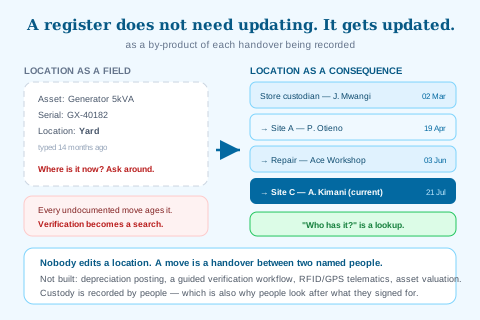
The single distinction that separates a living register from a decaying one is whether every asset has a named person responsible for it at all times.
Not a department — departments do not answer questions. A person. When a laptop moves from one employee to another, that is a custody transfer with two names and a date. When a generator goes from the yard to a site, somebody at the site accepts it. The asset is never in a state where the honest answer to "who has this?" is "the company".
A register without custody
- Location is a field somebody typed once
- "Who has it?" is answered by asking around
- A move leaves no trace, so the register silently ages
- Annual verification is a search, and things are written off as missing
- Nobody is accountable, so nothing is treated as anyone's to protect
A register with custody
- Location is a consequence of who currently holds it
- "Who has it?" is a lookup with a name and a date
- Every move is a recorded handover between two named people
- Verification confirms what the record already says
- People look after equipment they have signed for
People look after equipment they have signed for. That is not a control mechanism, it is human nature — and it does more for asset preservation than any tagging exercise.
What belongs on the record
Less than people expect, and different from what most spreadsheets hold.
| Field | Why it earns its place | The common mistake |
|---|---|---|
| Current custodian | It is the only field that answers the question anyone actually asks | Recording a department, which cannot be asked anything |
| Serial number | The one identifier that survives re-tagging and renaming | Relying on an internal tag that falls off |
| Purchase date and cost | The basis for depreciation, insurance and replacement planning | Recording the invoice total for a batch rather than per asset |
| Status | In use, in store, under repair, disposed — drives every report | A free-text field that becomes forty variations of "working" |
| Movement history | Turns a snapshot into something auditable | Overwriting location instead of appending a movement |
| Warranty expiry | Cheap to record, repeatedly valuable | Discovering the warranty expired last month |
| Funding source | Essential for donor-funded equipment | Absent, so nobody can answer which grant bought what |
The status field deserves a rule: it must be a fixed list, not free text. A register where status is typed produces "working", "Working", "in use", "OK" and "with John" as distinct values, and every report built on it is wrong in a way that takes an afternoon to discover.
Verification is a rhythm, not an event
The annual asset verification is the moment most organizations discover how bad their register is, and it is usually treated as a compliance chore to survive rather than a control. Both problems have the same fix: verify continuously in slices rather than exhaustively once.
This is the same logic as cycle counting versus annual stocktake applied to fixed assets. A department a month, confirmed against the register by someone who is not the custodian, finds a discrepancy within weeks of it occurring — when the person who moved the item still remembers moving it. An annual sweep finds the same discrepancy eleven months late, when the only available conclusion is "missing".
-
Build the register from a physical walk, not from invoices
Walk the building and record what is there. Building from purchase records produces a register containing assets that were disposed of years ago and missing everything bought informally.
-
Assign a custodian to every single item
Including shared and stored items, which go to a store custodian rather than to nobody. "Unassigned" should be an exception you can report on, not a resting state.
-
Make movement the only way location changes
Nobody edits a location field. A move is a handover with two names and a date, which means history accumulates rather than being overwritten.
-
Verify a slice monthly
One department, site or category per month, checked by someone other than the custodian. Twelve slices is a full verification with none of the disruption.
-
Close the loop on disposals
A disposed asset is marked disposed with a date and an authorisation, not deleted. Deleting it destroys the history that explains where it went.
The handover that prevents most losses
Exit. When someone leaves, the assets in their custody should be formally handed back before the final payment is released — laptop, phone, tools, keys, vehicle. Organizations that do not connect the exit process to the asset register lose equipment at every departure and only notice at the next verification, by which point recovery is a conversation with a former employee.
Assets that move every week
Some categories break the "one custodian, occasional move" model entirely. Contractor plant covers three sites in a month. A pool vehicle has a different driver daily. Tools go out and come back. Treating those like a desk that never moves guarantees the register is wrong.
The pattern for these is check-out and check-in against a custodian rather than a permanent assignment — the discipline documented for contractors in plant and equipment custody and for field and van operations in van stock and site custody. Fleet-specific concerns including fuel are in fleet and fuel control.
Donor-funded assets carry an extra obligation
For NGOs and grant-funded programmes an asset register is not only a management tool — it is a reporting requirement. Donors ask what was bought with their money, where it is now, who holds it, and what happens to it at the end of the programme. Each of those is trivial with custody and funding source on the record, and genuinely difficult without.
That is why funding source belongs as a field rather than a note, and why disposal needs an authorisation trail — end-of-programme asset disposition is frequently governed by the grant agreement. The practice is set out in donor-funded asset registers and the audit context in audit readiness.
What we do and do not do
What AWRA OpsHub does today
- A register with named custody — every asset has a current custodian, and custodians can be employees or non-employees such as contractors and departments.
- Movement history — each handover recorded rather than a location field overwritten.
- Serial numbers, purchase date and cost, status and warranty expiry on the record.
- Check-out and check-in for equipment that moves regularly.
- Assets linked to the employee record, so what someone holds is visible on their profile and at exit.
- Funding source and procurement linkage, so donor-funded equipment traces to the grant that bought it.
- Conversion between stock and assets, for items that start as inventory and become fixed assets.
More we can add to your workspace
- A depreciation schedule computed and posted. Purchase date and cost are already held against every asset; the method, the rate and the posting rules are the build. The concepts are in depreciation methods.
- A guided verification round. A driven audit process with a scope, an assignee and a completion state, instead of a rhythm you run against the register yourself.
- Planned maintenance. Condition monitoring, meter and hours-based service intervals and a work-order engine, sitting on the asset beside its custody history.
- RFID and GPS telematics. Custody sensed by devices and reconciled against the register, rather than recorded by a person at each handover.
Where we point you to a specialist
- Depreciation treatment and asset valuation stay with your accountant. Which method applies, what an asset is worth for statutory accounts and what the fixed-asset note must say are judgements we will not make for you, however good the schedule above gets.
The management view here and your accountant's statutory view can legitimately differ. Confirm the treatment with them.
Anything above that you need, we can build for you
Everything listed above as something we can add describes what ships in the standard product today — it is a starting point, not a limit on what AWRA OpsHub can do for your organisation. Kenya's eTIMS integration and its maintained payroll engine are both in the product because clients needed them and commissioned them; neither appeared by itself, and the same door is open for whatever you just read about. One qualification so this is worth what it claims: a small number of things on this blog we deliberately leave to a specialist rather than build — a statutory ledger we will not sign our name to, a rule that would decide a tax question for you, a clinical or member-funds record that belongs in a regulated system — and where that is true the post says so in those words. Everything else is a scope, a timeline and a price.
The operational work, which is what most commissions actually are
An extra approval stage in a chain that does not match the standard one, a custom field set on employees or assets that only your sector needs, an expiry that has to block an order rather than send an email, a report your board asks for in a shape nothing produces, or a scanner or weighbridge feeding the goods-in door. These are the commissions we are asked for most often and the smallest ones we quote — and unlike a revenue-authority pipeline, none of them waits on a regulator.
The module-shaped additions, which are the ones readers ask for most often
A price list with real discount authority, a customer-facing quotation that expires, a bill of materials or recipe costing, a staff advance that is issued, acquitted and chased, a member or unit ledger, a matching rule that holds a payment. Each of these is a build rather than a setting, and each has been quoted before — a bigger piece of work than a custom field, with a written spec and a date instead of a roadmap slide.
The report, document or pack nothing currently produces
The board pack in the shape your board actually asks for, a donor or funder layout, an invoice or receipt template carrying what your regulator or your customer expects, a dataset the report builder cannot reach yet. Usually the fastest thing on this list to deliver, because the data is already in the system.
Systems, rails and hardware you already run
The accounting package, CRM, online store, core banking or custom database you intend to keep — connected through our API so a fact is entered once and appears everywhere it is needed. Plus the physical edge: a scanner, a scale, a weighbridge or a till peripheral feeding the door it belongs to.
How it works: you describe the requirement, we return a written scope, timeline and cost, and once agreed it is built into your environment and maintained as part of the product. Nothing here waits on a regulator or a published specification, which is why operational builds are the ones we quote fastest. Tell us the requirement that would otherwise rule us out — that is a better first conversation than a demo.
Tell us what your operation needsWhere the value actually shows up
Asset registers rarely produce a visible saving, which is why they get deferred behind everything else. The return arrives as absences — the departure that does not lose a laptop, the audit that asks about equipment and gets an answer, the site that stops buying a second angle grinder because nobody could find the first one, the warranty claim made in time.
And one visible one: organizations that install custody properly usually find equipment they had already written off. Not because it was hidden, but because "missing" was the only available conclusion in a system that could not say who last had it.
Our take
Build the register by walking the building, give every item a named custodian including stored ones, make movement the only way location changes, and verify a slice each month. Then connect the exit process to the register. That last step alone pays for the exercise in most organizations with any staff turnover.
See a register that stays true
Named custody on every asset, movement recorded as handovers, check-out and check-in for equipment that travels, and funding source for donor-purchased items.
Explore AWRA AssetsFrequently asked questions
How do we build an asset register from scratch?
Walk the building and record what is physically there, rather than building it from purchase invoices. Invoice-derived registers contain assets disposed of years ago and omit everything acquired informally, which means you start with a document nobody trusts. Then assign a custodian to every item — including stored and shared equipment, which goes to a store custodian rather than to nobody.
Does it calculate depreciation?
No. Purchase date and cost are held on the record, but there is no depreciation engine and nothing is posted to your accounts as a depreciation schedule. That is your accountant's treatment and it can legitimately differ from a management view. We would rather state that plainly than let you assume the fixed-asset note in your statutory accounts will come out of here.
What about equipment that moves between sites every week?
Use check-out and check-in against a custodian rather than a permanent assignment. Contractor plant, pool vehicles and tools break the "one custodian, occasional move" model, and treating them like a desk guarantees the register is wrong within a month. The contractor version of this discipline is covered in plant and equipment custody.
How often should we verify assets?
Continuously in slices — one department, site or category per month, checked by someone who is not the custodian. Twelve slices give you a full annual verification with none of the disruption, and more importantly they find a discrepancy within weeks of it happening, while the person who moved the item still remembers. An annual sweep finds the same discrepancy eleven months late, when "missing" is the only available conclusion.
How do we stop losing equipment when staff leave?
Connect the exit process to the register: assets in someone's custody are formally handed back before the final payment is released. Because assets are linked to the employee record, what a leaver holds is visible on their profile rather than requiring somebody to remember. Organizations without this link lose equipment at every departure and discover it at the next verification, when recovery means a conversation with a former employee.
