
Best Smart Inventory & Intelligent Procurement System for Kenyan Businesses (2026)
The gap between a business that merely records stock and one that is told what to buy, when, and from whom — is the difference between digital and intelligent. Here is what "smart inventory" and "intelligent procurement" actually mean in 2026, and how to choose a system that delivers both for a Kenyan operation.
Almost every business past a certain size has "digitized" its inventory and buying — a system that records what came in, what went out, and what a purchase order said. That is table stakes, and it is not what this guide is about. The real question in 2026 is whether your system merely stores those facts or actually acts on them: whether it tells you what to reorder before you stock out, flags the stock quietly dying on your shelves, pre-selects the supplier who has earned it, and refuses to pay an invoice that does not match what arrived. That shift — from recording to deciding — is the line between a digital system and a smart one, and it is where the return on the investment actually lives.
What makes inventory actually "smart"
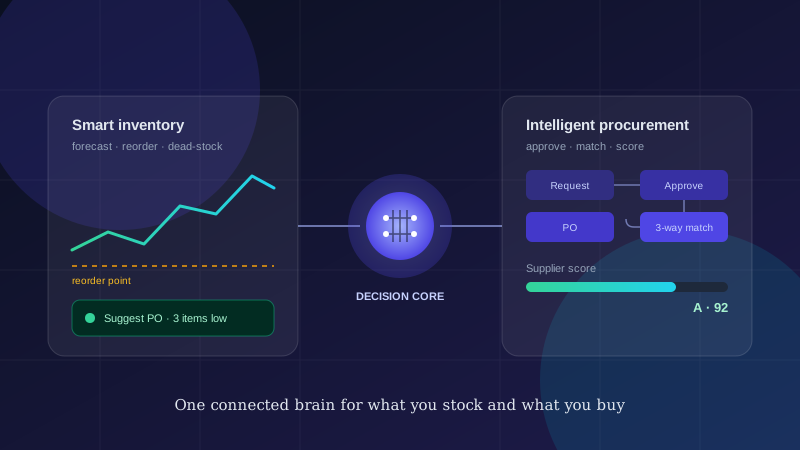
"Smart" is an abused word, so let us make it concrete. A smart inventory system does four things a merely digital one does not, and each maps to a decision you would otherwise make by gut or not at all.
- Reorder intelligence — it computes reorder points and safety stock from real sales velocity and lead time, and tells you what to buy before the shelf is empty, instead of waiting for someone to notice.
- Demand awareness — it reads the trend, not just today's balance, so seasonal and accelerating lines are reordered on where demand is going, not where it was.
- Dead-stock detection — it surfaces slow and non-moving stock automatically, while there is still cash to recover, rather than at a year-end write-off.
- Focus by value — it applies ABC analysis so your tightest control lands on the items that tie up the most money, not evenly across a flat catalogue.
Underneath all four sits one non-negotiable foundation: a live, perpetual stock record that updates on every movement. Intelligence built on numbers that are only true on counting day is not intelligence; it is confident guessing.
What makes procurement "intelligent"
Intelligent procurement is the same principle applied to money leaving the business: the system does not just record purchases, it governs and improves them. That means commitment is controlled before it happens, payment is protected by matching, and suppliers earn their next order on evidence.
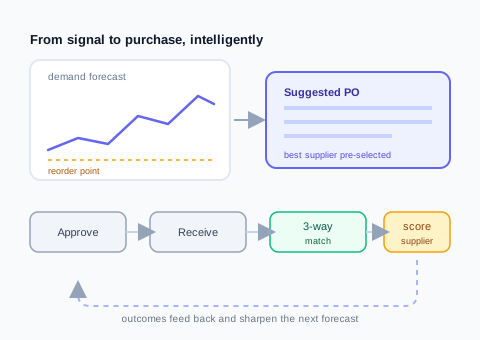
The intelligent procurement loop begins where smart inventory ends. A reorder signal becomes a suggested purchase order, with the supplier who has delivered best on price, lead time, and quality already pre-selected. The requisition is approved before commitment by somebody holding the grant to approve it, so nobody binds the business to spend nobody sanctioned. When goods arrive, three-way matching checks the purchase order against the delivery against the invoice before a shilling is paid. And the outcome — did this supplier deliver on time, in full, at the agreed price? — updates their score, sharpening the next suggestion. Buying stops being a series of one-off phone calls and becomes a system that gets smarter with every order.
Why the two must live in one system
The most common and most expensive mistake is buying smart inventory and intelligent procurement as two separate tools that "integrate." They should not integrate; they should be the same system, because they are the same loop. What you hold determines what you should buy; what you buy changes what you hold; and the money side — cost of goods, supplier terms, landed cost — only makes sense when both halves share one set of records. Split them across two products joined by a nightly sync and you reintroduce exactly the gaps — stale numbers, double entry, reconciliation labor — that intelligence was supposed to remove.
The Kenya layer that generic systems miss
A system can be brilliant at forecasting and still be useless in Nairobi if it cannot handle the realities Kenyan businesses actually operate in. The features that separate a system built for Kenya from a foreign one retrofitted for it:
- eTIMS on every sale — KRA-compliant invoicing generated from the ordinary selling flow, not a bolt-on you maintain.
- M-Pesa-native reconciliation — mobile-money receipts matched against recorded sales, because that is how Kenyan customers actually pay.
- Multi-branch reality — governed transfers and per-branch visibility, since growth here means a second and third location, not a bigger single shop.
- Offline resilience — selling and capture that survive a dropped connection and sync when it returns, because connectivity is not guaranteed.
- Prices in KES, support in your timezone — published pricing and people who answer, not a dollar quote and a ticket queue.
Digital vs smart: what to actually demand
| Capability | Merely digital | Smart & intelligent |
|---|---|---|
| Stock figure | Recorded, trued up at counts | Live, perpetual, always current |
| Reordering | Someone notices and buys | System suggests, timed to lead time & velocity |
| Slow stock | Found at year-end write-off | Flagged automatically while recoverable |
| Purchasing | PO typed after a phone call | Suggested PO, best supplier pre-selected |
| Approvals | Convention, hopefully followed | Enforced by value threshold before commitment |
| Paying suppliers | Invoice paid on trust | Three-way matched before payment |
| Suppliers | Chosen by habit | Scored on price, lead time, and reliability |
| Kenya compliance | eTIMS/M-Pesa bolted on | Native and maintained for you |
Your evaluation checklist
Ask any shortlisted system to demonstrate — on your own data — that it can:
- Show a live stock figure that moves the instant a sale, receipt, or transfer happens.
- Generate a reorder suggestion for a real item, and explain the number behind it.
- Surface your slowest-moving stock without you building a report by hand.
- Turn a low-stock signal into a pre-filled purchase order with a supplier pre-selected.
- Block a purchase order that exceeds an approval threshold until it is authorized.
- Refuse to match an invoice whose quantity or price differs from the PO and delivery.
- Produce a compliant eTIMS receipt and reconcile an M-Pesa payment in the normal flow.
- Do all of the above across two branches from one screen — and keep with stock and asset movement captured offline.
A system that can demonstrate that list on your own items and suppliers is smart and intelligent in the only sense that matters — it makes better decisions with you, not just faster paperwork. That is precisely what AWRA OpsHub is built to do for Kenyan operations: one connected system where smart inventory and intelligent procurement share a single brain, priced in KES and built for eTIMS, M-Pesa, and the way businesses actually run here.
See the smartest version of your own operation
Bring one messy item list and one real supplier — watch reorder suggestions, a pre-filled PO, three-way matching, and eTIMS all run on your data, across your branches.
See AWRA for Kenyan operationsFrequently asked questions
What is the difference between a "digital" and a "smart" inventory system?
A digital system records what you have; a smart one acts on it. Smart inventory computes reorder points from real sales velocity and lead time, reads demand trends, flags dead stock automatically, and focuses control on high-value items via ABC analysis — all on a live perpetual record. The test is simple: does it tell you what to do, or just store what happened?
What makes procurement "intelligent" rather than just digital?
Intelligent procurement governs and improves buying rather than merely recording it: it turns a low-stock signal into a suggested purchase order with the best-scoring supplier pre-selected, enforces approval before commitment, protects payment with three-way matching, and scores suppliers on price, lead time, and reliability so each order sharpens the next. It gets better with use.
Should inventory and procurement be one system or two integrated tools?
One system. They are the same decision loop — what you hold determines what you buy, and what you buy changes what you hold. Splitting them across two products joined by a nightly sync reintroduces stale data, double entry, and reconciliation labor. Shared records are what make the intelligence trustworthy.
What should a Kenyan business specifically demand from such a system?
Beyond the intelligence: eTIMS-compliant invoicing generated from the normal sale, M-Pesa-native reconciliation, governed multi-branch transfers and visibility, offline resilience for unreliable connectivity, and pricing in KES with local support. A system brilliant at forecasting is still useless locally if it cannot handle how Kenyan businesses actually sell, pay, and operate.
How do I evaluate whether a system is genuinely smart?
Make it prove itself on your own data: show a live stock figure, generate and explain a reorder suggestion, surface your slowest stock, turn a signal into a pre-filled PO, block an over-threshold purchase, reject a mismatched invoice, produce an eTIMS receipt, and do it across branches and offline. Anything that cannot be demonstrated on your items and suppliers is a slogan, not a capability.