
Project Management Software in Kenya: Budget, Time & Real Profitability
Most Kenyan organizations running projects can tell you what a project was supposed to cost and what it eventually cost. The expensive gap is the middle — the months where an overrun was forming and nobody could see it yet.
Every organization that runs projects has had the same conversation. The job is finished, the final numbers are in, and it made far less than anyone expected. Somebody asks where it went wrong. The honest answer is usually that it went wrong in month two and everyone found out in month seven, because the information that would have shown it was scattered across a procurement file, a timesheet nobody totalled, and a stores issue booked to no job at all.
That is what project software is actually for. Not Gantt charts — Gantt charts are how you plan. The value is in knowing, this week, what a live job has consumed against what it was budgeted, while there is still a job left to correct.
Who this is for, because "project" means four different things
Contractors
Fixed-price work against a BQ
Materials, labour and plant against priced lines, with retention and variations. The construction-specific version is in BQ vs actuals.
Professional firms
Billable time against a fee
Time is the inventory. Recovery rate and write-offs decide profitability — see engagement profitability.
NGOs & programmes
Donor budgets with eligibility
Budget lines are constraints rather than targets, and burn rate matters more than margin. See grant budget tracking.
Internal projects
A capital or change budget
An approved amount, a sponsor and an appetite for spending it quietly. Cost allocation is the whole discipline.
The vocabulary differs and the underlying requirement does not: every cost that lands anywhere in the business must be attributable to the job that caused it, at the moment it is incurred rather than at reporting time.
The four leaks, and why each one hides
Project margin does not disappear in one place. It leaks in four, and each leak is invisible for its own reason.
| Leak | Why nobody sees it | What closes it |
|---|---|---|
| Staff time not charged to the job | Salaries are a monthly total, not a per-project cost, so the biggest cost on most projects is invisible | Time captured against tasks, costed, and reported per project |
| Stock issued to "the site" or "the office" | The issue is recorded, so it feels controlled — but not against a job | Every issue booked to a project, and refused if it is not |
| Procurement committed before it is budgeted | A purchase order is a commitment; most systems only show invoices | Commitment visible against the budget line at approval, not at invoice |
| Scope that grew without a variation | Each extra request was small and the client or sponsor was reasonable | Variations recorded as budget changes, with an approval, or not done |
The largest cost on most projects is people, and it is the one cost that almost never appears on the project. That is not an accounting oversight — it is the reason the final number surprises everybody.
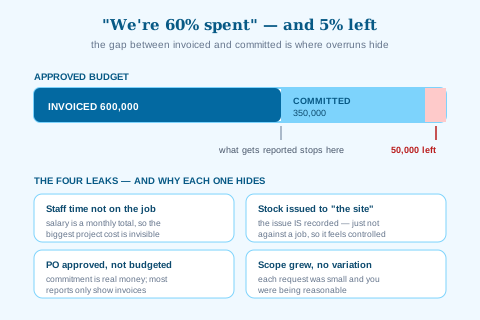
Committed is the number nobody tracks
Ask most project managers what a job has spent and they will tell you what has been invoiced. That is the wrong number, and being wrong in the safe direction makes it dangerous: it always looks better than reality.
A budget line has three states worth seeing. There is what you have spent — invoiced, and often already paid. There is what you have committed — approved purchase orders where the money is legally promised but nothing has arrived. And there is what remains genuinely available. A project that looks 60% spent can be 95% committed, which means the decision you think you still have has already been made.
The number that matters on a live job
Illustrative, in KES. Reported as "60% spent" the line looks comfortable. It has 5% left. Every organization that has been surprised by a project overrun has been surprised by this specific gap.
Time is a cost even when it is not billable
Professional firms understand that time is their inventory. Everyone else tends to treat staff time as a fixed overhead that projects consume for free — and then cannot explain why a portfolio of apparently profitable projects produces a business that is not.
Capturing time against tasks does not require six-minute increments or surveillance. It requires that the day is attributed to something at a resolution good enough to be useful, and that the resulting cost lands on the project. Half-day granularity, consistently applied, beats perfect granularity nobody sustains — and for firms that bill it, the mechanics of getting from capture to invoice are covered in billable time in Kenya.
What we do and do not do
What AWRA OpsHub does today
- Projects with budgets, broken into lines you can measure against.
- Tasks, dependencies and assignment, with planning and Gantt views.
- Time entries against tasks, costed and reported per project.
- Procurement tied to projects, so commitment is visible against the budget at approval rather than at invoice.
- Stock issues booked to a project, so materials land on the job that consumed them.
- Budget vs committed vs actual on one view, while the job is running.
More we can add to your workspace
- Resource levelling and earned-value automation. A dependency graph and a critical path already exist; optimisation against resource availability and automated earned-value reporting are the build on top.
Where we point you to a specialist
- We do not do BQ take-off or measurement — quantities come from your QS, not from drawings.
- We do not price your work. The system tells you what a job costs; what to charge is your commercial judgement.
- We do not manage client contracts as legal instruments — variations are recorded as budget changes, not drafted.
For construction specifically, treat this as the cost and commitment layer beneath your QS process rather than a replacement for it.
Anything above that you need, we can build for you
Everything listed above as something we can add describes what ships in the standard product today — it is a starting point, not a limit on what AWRA OpsHub can do for your organisation. Kenya's eTIMS integration and its maintained payroll engine are both in the product because clients needed them and commissioned them; neither appeared by itself, and the same door is open for whatever you just read about. One qualification so this is worth what it claims: a small number of things on this blog we deliberately leave to a specialist rather than build — a statutory ledger we will not sign our name to, a rule that would decide a tax question for you, a clinical or member-funds record that belongs in a regulated system — and where that is true the post says so in those words. Everything else is a scope, a timeline and a price.
The operational work, which is what most commissions actually are
An extra approval stage in a chain that does not match the standard one, a custom field set on employees or assets that only your sector needs, an expiry that has to block an order rather than send an email, a report your board asks for in a shape nothing produces, or a scanner or weighbridge feeding the goods-in door. These are the commissions we are asked for most often and the smallest ones we quote — and unlike a revenue-authority pipeline, none of them waits on a regulator.
The module-shaped additions, which are the ones readers ask for most often
A price list with real discount authority, a customer-facing quotation that expires, a bill of materials or recipe costing, a staff advance that is issued, acquitted and chased, a member or unit ledger, a matching rule that holds a payment. Each of these is a build rather than a setting, and each has been quoted before — a bigger piece of work than a custom field, with a written spec and a date instead of a roadmap slide.
The report, document or pack nothing currently produces
The board pack in the shape your board actually asks for, a donor or funder layout, an invoice or receipt template carrying what your regulator or your customer expects, a dataset the report builder cannot reach yet. Usually the fastest thing on this list to deliver, because the data is already in the system.
Systems, rails and hardware you already run
The accounting package, CRM, online store, core banking or custom database you intend to keep — connected through our API so a fact is entered once and appears everywhere it is needed. Plus the physical edge: a scanner, a scale, a weighbridge or a till peripheral feeding the door it belongs to.
How it works: you describe the requirement, we return a written scope, timeline and cost, and once agreed it is built into your environment and maintained as part of the product. Nothing here waits on a regulator or a published specification, which is why operational builds are the ones we quote fastest. Tell us the requirement that would otherwise rule us out — that is a better first conversation than a demo.
Tell us what your operation needsWhere to start
-
Pick one live project, not the portfolio
Preferably one that is worrying you. A single job tracked properly for a month makes the case better than any business case.
-
Budget it in lines you can actually measure
Lines that match how cost arrives — materials, labour, subcontract, plant, other. Ten useful lines beat sixty aspirational ones.
-
Close the two easy leaks first
Stock issues must name a project; purchase orders must name a project. Both are one-field changes and together they usually account for most of the invisible cost.
-
Add time capture at a granularity people will sustain
Whatever they will actually do every day. Consistency beats precision.
-
Review committed vs actual weekly
Weekly, not monthly. Monthly review finds overruns that have already happened; weekly finds them while a decision is still available.
The rule that does most of the work
Nothing gets issued from stores and no purchase order gets approved without naming a project. It sounds bureaucratic and it takes about a week for people to stop resenting it. It is also, on its own, the difference between knowing which of your jobs make money and guessing.
Our take
Track committed cost, not just invoiced, and put staff time on the job even when it is not billable. Those two changes turn project reporting from a post-mortem into a steering wheel. Everything else — Gantt charts, dependencies, resource views — is planning, and planning has never been the reason a Kenyan project lost money.
See budget, committed and actual on one view
Projects with real budget lines, procurement and stock issues booked to the job, time costed against tasks, and an overrun visible while you can still act on it.
Explore AWRA ProjectsFrequently asked questions
What is the difference between committed and actual cost?
Actual is what has been invoiced — and often already paid. Committed is what you have legally promised through approved purchase orders and subcontracts but not yet received or been invoiced for. Reporting only actuals makes a project look better than it is, always in the same direction, which is why a job that reads as 60% spent can have 5% genuinely available. Seeing both against the budget line is the single most useful project control there is.
Do we have to track time to the minute?
No, and trying to usually kills adoption. What matters is that time is attributed to a project consistently at a granularity your team will sustain every day — half-days are often enough for internal cost visibility. Firms that bill time need finer capture because the entry becomes an invoice line, but even there consistency matters more than precision, since a timesheet nobody completes is worth nothing however granular its design.
Can it handle donor-funded project budgets?
Yes, and the shape is the same: budget lines, commitment visible at approval, actuals against the line. What donor work adds is that lines are eligibility constraints rather than targets, so the useful behaviour is the system refusing an ineligible commitment rather than reporting it afterwards. Grant-specific practice — burn rate, restricted funds, reporting — is covered in our NGO guides, particularly grant budget tracking.
Is this a replacement for our QS process on construction jobs?
No. There is no take-off or measurement from drawings, and quantities still come from your quantity surveyor. Treat it as the cost and commitment layer underneath: the BQ becomes the budget, and materials, labour, plant and subcontract costs are measured against those lines as the work runs. The construction-specific version of this discipline is covered in BQ vs actuals.
Why do projects that look profitable individually add up to a business that is not?
Almost always because staff time is treated as a free overhead that projects consume without being charged for it. Each project shows a margin over its direct costs, the salary bill sits outside all of them, and the arithmetic never reconciles. Putting labour cost on the job — even at a simple standard rate — usually reveals that a subset of work was never viable, which is uncomfortable and considerably cheaper than continuing to take it on.
