
Sales Software in Kenya: Quote to Cash Without the Gaps
A Kenyan sale is not finished when the customer says yes. It is finished when the money is in the bank, the stock has moved, and the invoice matches what was actually delivered — and the gaps between those steps are where revenue quietly evaporates.
Most Kenyan businesses track two points in a sale: the moment a customer agrees, and the moment cash appears. Everything in between is assumed to work, and mostly it does. But the assumptions are where the money goes — a quotation honoured at a price nobody approved, goods delivered short and invoiced full, an invoice raised for stock that was never moved out of the system, a payment received against no particular invoice.
None of those are dramatic. They are small, individually defensible gaps that recur, and their combined effect is a business that sells well and collects poorly while nobody can point at the reason.
The chain, and what breaks at each link
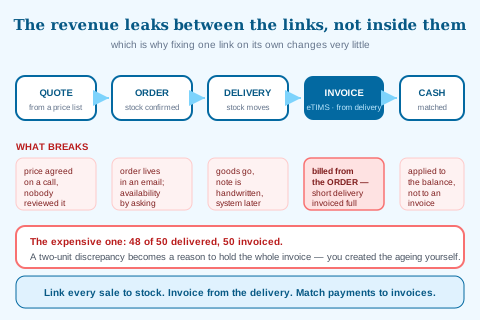
Quote to cash is five links. Each one has a characteristic failure.
| Link | What should happen | What usually happens instead |
|---|---|---|
| Quotation | A priced offer from a price list, with any discount authorised | A number agreed on a call and typed into a document, at a price nobody reviewed |
| Order | The accepted quotation becomes an order, with stock reserved or confirmed available | The order lives in an email, and availability is checked by asking the storekeeper |
| Delivery | Stock moves, and what physically went is recorded | Goods go out, the note is handwritten, and the system finds out later — or not |
| Invoice | Raised from what was actually delivered, VAT-aware, eTIMS-compliant | Raised from the order, so short deliveries are invoiced in full and disputed later |
| Collection | Payment matched to specific invoices, ageing visible weekly | Money arrives, gets applied to the oldest balance, and nobody can reconcile a statement |
The fourth row causes more customer disputes than anything else on the list. Invoicing from the order rather than the delivery is faster and feels harmless — until a customer receives 48 of 50 units, is billed for 50, and now has a reason to delay the entire invoice while the difference is investigated. You have converted a two-unit problem into a full-invoice ageing problem.
Invoice what you delivered, not what you promised. Every shilling of the difference becomes a reason for the customer to pay none of it yet.
Every sale must move stock
This is the one rule that turns sales from a record of intentions into a record of events. If a sale can be recorded without inventory moving — or stock can leave without a sale being recorded — then your stock position and your revenue are two independent stories, and reconciling them becomes a monthly investigation rather than an automatic consequence.
It also closes the most common shrinkage route in Kenyan retail and distribution: goods leaving against a sale that was never entered. When the two are structurally linked, that requires a deliberate act rather than an omission, which changes the arithmetic for anyone considering it. The anatomy of retail loss is covered in shrinkage control, and the daily reconciliation habit in the retail daily close.
eTIMS is the one place Kenya is easier than everywhere else
We have spent a lot of this blog telling businesses in Nigeria, Ghana, Uganda, Tanzania and Rwanda that we do not integrate with their fiscal e-invoicing regime and that they should not buy on the assumption we do. Kenya is where that sentence reverses: eTIMS is the fiscal integration we actually built, and it is the one we can demonstrate rather than describe.
What AWRA OpsHub does today
- eTIMS integration for Kenya — the one fiscal e-invoicing regime we support directly rather than reconcile against.
- Every sale moving stock in the same transaction.
- VAT-aware records with net, tax and gross separated on every line.
- Payments matched to specific invoices, with ageing and customer statements.
- Every discount recorded on the sale and on the line, and margin by item costed on weighted average cost.
- Credit limits with live exposure that place a real hold at invoicing.
More we can add to your workspace
- A price list, and a discount authority. A selling price sits on the item; nothing grants, limits or approves a departure from it. Discounts are recorded rather than authorised, which is a materially weaker control than the one this section previously implied.
- A customer-facing quotation, and a sales order. The quotation in this system belongs to a vendor and an RFQ — the buying side — and the invoice is the first sales document, so the quote-to-order-to-invoice chain is what these two add.
- A margin by customer or salesperson. Margin is grouped by item, and no salesperson is recorded on a sale or an invoice.
- Automated dunning. Reminder sequences on a schedule you set, with the record of who was reminded held on the invoice. Ageing and statements ship today; the phone call stays a person's.
Where we point you to a specialist
- We do not assess credit risk. We enforce the limit you set and we cannot tell you whether a customer deserves it, which is a judgement about their business rather than a calculation about yours.
- We do not set your prices or advise on discount strategy. What to charge is the most consequential commercial decision a business makes and it is not one to hand to a vendor.
- We are not a full CRM. There is customer history and context, but no marketing automation, lead scoring or campaign management.
Price lists, customer tiers, discount authority and a customer-facing quotation are scope rather than ceilings — but a substantial build rather than a setting, and it would be dishonest to imply otherwise.
⚠️ Corrected 7 August 2026. This block previously listed "quotations from price lists with discount authority granted to named roles" and "orders becoming deliveries becoming invoices" as shipping. Both are builds: the price list, the discount authority, the customer quotation and the sales order are all in the middle column. The eTIMS, stock-movement, VAT and payment-matching claims are unchanged and verified. eTIMS rules, VAT rates and thresholds are set by KRA and change — confirm current requirements with KRA or your tax adviser, as this is not tax advice.
Anything above that you need, we can build for you
Everything listed above as something we can add describes what ships in the standard product today — it is a starting point, not a limit on what AWRA OpsHub can do for your organisation. Kenya's eTIMS integration and its maintained payroll engine are both in the product because clients needed them and commissioned them; neither appeared by itself, and the same door is open for whatever you just read about. One qualification so this is worth what it claims: a small number of things on this blog we deliberately leave to a specialist rather than build — a statutory ledger we will not sign our name to, a rule that would decide a tax question for you, a clinical or member-funds record that belongs in a regulated system — and where that is true the post says so in those words. Everything else is a scope, a timeline and a price.
The operational work, which is what most commissions actually are
An extra approval stage in a chain that does not match the standard one, a custom field set on employees or assets that only your sector needs, an expiry that has to block an order rather than send an email, a report your board asks for in a shape nothing produces, or a scanner or weighbridge feeding the goods-in door. These are the commissions we are asked for most often and the smallest ones we quote — and unlike a revenue-authority pipeline, none of them waits on a regulator.
The module-shaped additions, which are the ones readers ask for most often
A price list with real discount authority, a customer-facing quotation that expires, a bill of materials or recipe costing, a staff advance that is issued, acquitted and chased, a member or unit ledger, a matching rule that holds a payment. Each of these is a build rather than a setting, and each has been quoted before — a bigger piece of work than a custom field, with a written spec and a date instead of a roadmap slide.
The report, document or pack nothing currently produces
The board pack in the shape your board actually asks for, a donor or funder layout, an invoice or receipt template carrying what your regulator or your customer expects, a dataset the report builder cannot reach yet. Usually the fastest thing on this list to deliver, because the data is already in the system.
Systems, rails and hardware you already run
The accounting package, CRM, online store, core banking or custom database you intend to keep — connected through our API so a fact is entered once and appears everywhere it is needed. Plus the physical edge: a scanner, a scale, a weighbridge or a till peripheral feeding the door it belongs to.
How it works: you describe the requirement, we return a written scope, timeline and cost, and once agreed it is built into your environment and maintained as part of the product. Nothing here waits on a regulator or a published specification, which is why operational builds are the ones we quote fastest. Tell us the requirement that would otherwise rule us out — that is a better first conversation than a demo.
Tell us what your operation needsDiscount is where margin actually goes
Businesses hunt for margin in purchase prices, which is difficult, while giving it away at the counter, which is easy. A hundred small unrecorded concessions cost more than one bad supplier negotiation, and unlike the supplier negotiation nobody ever reviews them.
The fix is not to ban discounting — it is to make it a decision rather than an ambient practice. A price list, discount authority granted explicitly to named roles, and every departure recorded against the person who authorised it. Then margin by customer, by product and by salesperson becomes measurable, and the conversation shifts from "we need better prices" to "these three accounts are unprofitable at the terms we give them." That mechanic is covered in quotations, price lists and discount control.
Collection is a system problem, not a persistence problem
Kenyan businesses lose more to slow collection than to bad debt, and the usual response is to chase harder. But most late payment is not reluctance — it is friction: the customer cannot reconcile the invoice, the delivery note does not match, the statement shows a balance they dispute, or nobody asked until it was already old.
Which means collection improves most when invoicing improves. An invoice that matches the delivery, a statement the customer can reconcile, and ageing reviewed weekly rather than when someone stops answering. Receivables and collections covers the practice; the arithmetic of why it matters more than margin is in working capital and the cash conversion cycle.
Where to start
-
Link every sale to stock movement
Non-negotiable and first. Until this holds, neither your revenue nor your stock position is trustworthy, and nothing built on top of them is either.
-
Invoice from the delivery, never the order
One change that removes the most common cause of invoice disputes and therefore of ageing.
-
Put quotations on a price list with real discount authority
Margin stops leaking at the point of sale, and becomes measurable by customer and product. This one is a requirement to take to vendors rather than something to configure here — AWRA has no price list and no discount authority, so what you get from us at this step is the record of every discount and margin by item, which is the retrospective half.
-
Match payments to invoices
Not to balances. A customer who can reconcile their statement pays faster and argues less.
-
Review ageing weekly
Weekly, with a name against each overdue account. Monthly review discovers problems that are already old.
Our take
Link sales to stock, invoice from the delivery, and control discount at the point of sale. Those three close most of the gap between what a Kenyan business sells and what it actually banks — and none of them require selling more, negotiating better prices, or chasing customers harder.
See quote to cash without the gaps
Every sale moving stock in the same transaction, eTIMS handled directly, VAT separated on every line, payments matched to specific invoices, and credit limits that place a real hold.
Explore AWRA SalesFrequently asked questions
Does it handle eTIMS?
Yes — Kenya is the one country where we integrate with the fiscal e-invoicing regime directly rather than running alongside it, which is exactly why our guides for Nigeria, Ghana, Uganda, Tanzania and Rwanda are careful to say we do not do this for them. Ask us to demonstrate it live rather than take it on trust; that is the standard we hold other vendors to throughout this blog and it applies to us equally. eTIMS rules change, so confirm current requirements with KRA or your tax adviser.
Why invoice from the delivery rather than the order?
Because a short delivery invoiced in full gives the customer a legitimate reason to hold the entire invoice while the difference is investigated. You turn a two-unit discrepancy into a full-invoice ageing problem, and you spend collection effort on a dispute you created at invoicing. Invoicing what actually left the store costs nothing extra and removes the most common cause of invoice queries.
Is this a CRM?
Not in the sales-pipeline sense. There is customer history, contacts, credit position and full transaction context, which is what most Kenyan SMEs actually need, but there is no marketing automation, lead scoring or campaign management. If your requirement is managing a long consultative pipeline with forecasting, treat this as the quote-to-cash and customer-record layer and pair it with a CRM rather than expecting one.
How do we stop staff discounting away our margin?
The structural answer is a price list plus discount authority granted explicitly to named roles, so any departure from list is a recorded decision by someone entitled to make it. Be aware that AWRA does not provide that: there is no price list and nothing grants, limits or approves a discount. What you get here is the aggregate — every discount recorded on the sale and the line, and margin by item — which makes the leakage visible after the fact but does not prevent it. If preventive control is your requirement, make it an explicit question to every vendor, because it is among the most commonly claimed and least commonly built features in this category.
Can it enforce customer credit limits?
Yes, and enforce rather than warn — a limit that only warns is dismissed by whoever is busiest. Ageing is visible alongside the limit so exposure is reviewed weekly rather than discovered when a customer stops answering. What the system cannot do is tell you whether a customer deserves the limit in the first place; we are not a credit bureau, and that assessment remains yours.
