
Best ERP Software for African Businesses (2026)
A vendor-honest pillar guide for 2026 — why "best ERP in Africa" cannot be answered as a product ranking, the five things that genuinely change country to country and the much larger set that does not, how to test a regional claim in a demo, and where we would tell you to buy something else.
Search for the best ERP software for African businesses and you will be handed a ranked list. Every list is wrong, and not because the products on it are bad. It is wrong because "African businesses" is fifty-four regulatory environments, a dozen currency regimes, several official languages and an enormous range of support depth — and no ranking can be simultaneously true in Lusaka and Lagos.
What can be answered is a smaller and more useful question: which parts of this decision are the same everywhere, which parts are national, and how do you tell whether a vendor has actually done the national work or has simply put your country on a map. That is what this guide is. It includes the places where our own answer is no.
The five things that actually vary
Almost every difference that matters between buying operations software in Cairo, Accra, Nairobi or Gaborone reduces to these. Nothing else on a regional vendor slide is genuinely national.
Notice what is missing from that list: stock control, procurement approvals, asset custody, project costing, reporting. Those are the bulk of an operations system and they do not vary by country at all. A pattern of goods received without a purchase order is the same failure in Kampala and Casablanca.
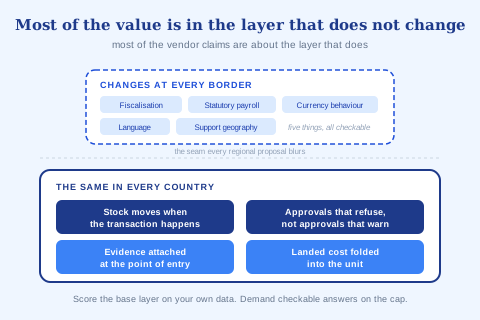
Why the invariant layer is where the money is
This is the part buyers systematically get backwards. Compliance features are the ones discussed in the meeting, because they are the ones with deadlines attached. But the loss that is actually running in your business, month after month, almost always sits in the layer nobody argues about.
What the meeting is about
- Whether the system transmits to the revenue authority.
- Whether payroll produces the statutory schedule.
- Whether there is a local partner in the country.
- Whether the interface is in the right language.
- All legitimate — and all binary questions with checkable answers.
What the money is actually doing
- Stock that is an estimate, so purchasing buys what is already in the building.
- Approvals that notify rather than refuse, so spend is governed retrospectively.
- Prices set off a supplier invoice rather than landed cost, quietly below the real floor.
- Evidence in a shared drive, so an audit or funder query costs a fortnight.
- None of these are national. All of them are expensive.
Compliance is the part with a deadline. Records are the part with a cost. Buyers negotiate hardest on the first and inherit the second.
The practical instruction is not to ignore compliance — it is to refuse to let compliance claims decide a purchase whose real return is elsewhere. Score the invariant layer first, on your data, in your demo. Then check the national layer for specifics.
Testing a regional claim
Every vendor selling across Africa has a slide with countries on it. Here is how to find out what is behind it, phrased so the answer is checkable rather than reassuring.
Six questions, and how to read the answers
Which of your fiscalisation integrations are live in production today?
What you will hear
A list of countries, sometimes with "and others in progress".
How to read it
Ask for a customer in each named country whose invoices went to the authority last month, and whether you can telephone them. A live integration has a reference. A roadmap has a slide. Our own list is exactly one country long, and it is below.
Who maintains the payroll tax bands, and how fast?
What you will hear
A reference to configurable tax tables or a local partner.
How to read it
"Configurable" almost always means you or your consultant maintain them, and that you find out about a change from your accountant. That is a legitimate product; it is a completely different promise from a maintained engine, and the price should reflect which you are buying.
What happens in the month between a budget change and your update?
What you will hear
Discomfort, then an answer about patch cycles.
How to read it
The most revealing question about payroll anyone can ask. A vendor with a real maintained engine has a rehearsed, specific answer because they have lived it. A vendor without one changes the subject to flexibility.
Can a storekeeper record a receipt with no connection?
What you will hear
A reference to cloud hosting and uptime.
How to read it
That answers a different question. Ask them to put a device into airplane mode, record a receipt and a count, reconnect, and show that nothing arrived twice. Watch whether they can, not whether they say they can.
Does the approval refuse, or notify?
What you will hear
A full approval workflow with thresholds and notifications.
How to read it
Notifications are not enforcement. Ask them to attempt the transaction above threshold, live, with no approval in place. The correct outcome is a refusal you cannot click past.
What would you not recommend yourselves for?
What you will hear
Frequently, nothing.
How to read it
The single most informative answer available in a sales meeting. A vendor with no boundary has either never examined one or has decided you should not see it.
The one-vendor-across-many-countries question
Groups operating in several African countries face a decision that gets framed as consolidation and is really about risk concentration. Both answers are defensible; the wrong one for you is expensive.
Choose one platform everywhere
When the operations are genuinely similar
Same processes, same reporting, one implementation team who get better with each rollout, one contract. The cost is compliance: you will still need local specialists in every country, and the platform will be strongest in whichever market its vendor comes from. Budget for the weakest country, not the strongest.
Choose local systems per country
When compliance dominates the workload
Each country buys the product that genuinely handles its fiscalisation and payroll. Compliance gets easier and group reporting gets much harder — you will be consolidating from several sources, and that reconciliation becomes a permanent job rather than a project.
Choose the split stack
Usually the honest answer
One operations platform everywhere for the invariant layer — stock, procurement, assets, projects, evidence — and local specialists per country for payroll and filing. You get comparable operations and correct compliance, at the cost of writing the boundary down and staffing both sides of it deliberately.
The third option is what we recommend and it is also what we sell, so weigh it accordingly. The reason we believe it rather than merely benefit from it is in the honesty ledger below: our compliance coverage is one country deep, and pretending otherwise across a continent would be the fastest way to lose the customers we have.
The buyer's scorecard
Everything here should be demonstrated live, on your data, in your demo. Not described, not screenshotted, not on a roadmap. It is deliberately weighted toward the invariant layer, because that is where the return is.
Pan-African operations software scorecard
Score every vendor including us. A vendor who scores well here and admits gaps above is worth more than one who claims everything.
Every sale and issue moves stock in the same second
Make them prove it: Record a sale, watch the level drop live, then run variance against a physical count.
Approvals that refuse rather than warn
Make them prove it: Attempt a purchase above threshold with no approval. The correct outcome is a refusal you cannot dismiss.
Source documents held against the transaction
Make them prove it: Open a purchase from a year ago and produce quote, approval, delivery note and invoice from the record — not a shared drive.
Landed cost folded into the unit
Make them prove it: Enter an import with freight, duty and clearing and show the receipt hitting stock at true cost.
Offline capture that survives an outage
Make them prove it: Airplane-mode a device, record a receipt and a count, reconnect, and confirm nothing duplicated.
The rate actually applied stored on the transaction
Make them prove it: Enter a foreign-currency purchase and find the rate on the record afterwards, not recalculated at report time.
Governed transfers between locations
Make them prove it: Move stock between two branches and show it in transit, belonging to neither until confirmed received.
Asset custody by named person and location
Make them prove it: Pick an asset at random. The system should say who holds it, where, and what funded it.
Honest, specific answer on fiscalisation
Make them prove it: Ask which integrations are live in production and for a customer you can phone in your country.
Honest, specific answer on payroll maintenance
Make them prove it: Ask who updates the bands and what happens in the gap month. Prefer a clear boundary to a vague yes.
Named implementers, not a partner map
Make them prove it: Ask for the people who would do yours and the last three projects they finished in your country.
Data residency and exit answered in writing
Make them prove it: Hosting region, access model, backup retention, and what you receive on termination — as a document.
A clean answer on what it does not do
Make them prove it: Ask what they would not recommend themselves for. No answer is itself an answer.
The straight answer on us
Here is our position across the continent, stated the way we would state it across a table rather than the way it would appear in a brochure.
What AWRA OpsHub does today
- The full operations layer, identical in every country — inventory across locations with governed transfers, procurement with requisitions, approvals that refuse and three-way matching, asset registers with named custody and verification, project and funder tracking, helpdesk, sales and customer records.
- Currency presets for every African currency, with the organization's base currency locked and foreign transactions recorded at the rate actually applied.
- Landed cost from freight, duty, clearing and handling, allocated onto the receipt.
- VAT and tax rate presets for the great majority of African countries, plus configurable additional tax lines with their own rates, effective dates and inclusive or exclusive treatment.
- Employee records, compensation, statutory identifiers, leave, attendance and payroll cost allocation, which work anywhere.
- Offline capture on mobile with a device register, queued operations carrying their own identifiers, duplicate-safe sync and a conflict view for administrators.
- An API, so the systems you intend to keep can stay connected rather than re-keyed.
More we can add to your workspace
- Fiscalisation in a second country. Kenya's eTIMS is our revenue-authority integration today, and it is the pattern FIRS, GRA, SARS, ZRA, ZIMRA, URA, TRA, RRA, ETA or DGI would follow — one authority at a time, built and maintained.
- Statutory payroll for a second country. Kenya's engine is turnkey; another country's income tax bands, social security contributions and statutory return formats are built and maintained the same way.
- More mobile money rails. M-Pesa in Kenya runs today, and MTN MoMo, Airtel Money, Orange Money, Wave, EcoCash and Telebirr are the same shape of integration.
- Automatic bank feeds in any market. Statements are imported and reconciled.
- A French, Arabic, Portuguese or Swahili interface, with right-to-left layout where the language needs it. The product is in English today.
- Tax presets are starting values, not a maintained rate history. You own the effective dates; confirm current treatment with your authority or adviser.
Where we point you to a specialist
- We are not a customs, clearing, freight, treasury, maintenance-management or manufacturing-execution system, and we do not produce statutory financial statements.
That asymmetry is deliberate and worth explaining rather than hiding. Kenya has eTIMS and a maintained payroll engine because Kenyan clients needed them and commissioned them — neither appeared because we decided a market mattered. It is the honest shape of a product built by request rather than by roadmap, and it means everything above is quotable rather than permanent.
What we can build for your market on top of the standard product
Everything listed above as something we can add describes what ships in the standard product today — it is a starting point for your market, not a limit on what AWRA OpsHub can do there. Kenya's eTIMS integration and its maintained payroll engine are in the product because Kenyan clients needed them and commissioned them; neither appeared by itself. The same door is open here. If a revenue authority pipeline, a bank or mobile money feed, a statutory return format, a rule specific to how your operation runs, or a link to a system you already have is what stands between you and a decision, tell us and we will scope it as a build — written spec, timeline and price — before you commit to anything.
Tax and e-invoicing pipelines
Electronic invoicing against your revenue authority's published interface, with the parts vendors gloss over — retries, a failure queue and a daily report of sales carrying no fiscal reference.
Banks, payments and mobile money
Statement feeds, payment gateways, bulk-payment files and collection accounts wired into the Payments Register so money in and out reconciles without re-keying.
The operational work, which is what most commissions actually are
An extra approval stage in a chain that does not match the standard one, a custom field set on employees or assets that only your sector needs, an expiry that has to block an order rather than send an email, a report your board asks for in a shape nothing produces, or a scanner or weighbridge feeding the goods-in door. These are the commissions we are asked for most often and the smallest ones we quote — and unlike a revenue-authority pipeline, none of them waits on a regulator.
Payroll and statutory returns
Payroll and social security schedules produced in the layout your filing body expects, generated from live payroll records rather than rebuilt each month.
Systems you already run
The accounting package, CRM, online store or custom database you intend to keep — connected through our API so a fact is entered once and appears everywhere it is needed.
How it works: you describe the requirement, we return a written scope, timeline and cost, and once agreed it is built into your environment and maintained as part of the product. No roadmap slide, and no pretending in a demo that something exists when it does not.
Tell us what you need integratedWhere we would tell you to buy something else
Four cases, stated plainly, where the right recommendation is not us.
- Your decision turns entirely on fiscalisation in a country we have not built. If invoices must reach your authority next quarter and nothing else matters, buy the local product that already does it. Ask us to scope a build only if you have time and a reason.
- You need a maintained payroll engine outside Kenya. Use a local bureau or payroll specialist. We hold the employee and cost side; we do not calculate national statutory payroll anywhere else.
- You need a right-to-left Arabic or a French interface today. We are English-only. In North and Francophone Africa that is a real constraint and we cover it honestly in Arabic and French localization and a French-language business buying English-language software.
- Your core need is planned maintenance, mine planning, customs clearing or treasury. Those are other people's products. We would rather connect to one than describe a movement log as a maintenance system.
The buying sequence
The order matters more than the vendor. Every step here is cheap to do first and expensive to do fourth.
-
Name your five variables
Write down your country's answer on fiscalisation, payroll, currency behaviour, language and support depth before you take a single demo. Half of your shortlist will disqualify itself against that page.
-
Count everything once, properly
A real physical count per location, reconciled and signed off. Every number for the next year is measured from this line.
-
Make every sale and issue move stock
No end-of-day batch updates. This single rule is what turns inventory from an opinion into a record.
-
Put teeth in the approvals
Thresholds that refuse, not thresholds that notify. Governance you can click past is documentation of the moment you were overruled.
-
Attach evidence at the point of entry
Quotes, delivery notes, invoices held against the transaction. This is what turns an audit from archaeology into an afternoon.
-
Divide the compliance work openly
Write the boundary down: what the platform holds, what local specialists own, and what crosses between them. Name an owner on each side before go-live.
The sector-neutral detail is in our ERP implementation checklist, and if you are still weighing whether to move at all, the true cost of running on spreadsheets is the baseline to measure any quote against.
Red flags
- A map of Africa with no country detail. Ask which integrations are live, in production, with a customer you can telephone.
- "Fully compliant" anywhere. Compliance is a property of your filing, not of a product. Ask what is submitted and by whom.
- Approvals that only warn. A control you can dismiss is a log.
- "Cloud, so no connectivity problems." Their uptime is not your branch's power. Ask about offline capture and duplicate-safe sync.
- Payroll described as compliant without naming who maintains the bands. The gap month is where this claim breaks.
- A partner network in place of named people. A network is a map. You need the three references.
- No opinion on what they are wrong for. A vendor with no boundary has not examined one.
Where to go next
By module, continentally: inventory management for Africa, procurement for African NGOs and enterprises, asset management for African organizations, HR and payroll across many countries, and multi-currency for pan-African operations.
By theme: cloud, connectivity and data residency, AfCFTA and cross-border trade, mobile money reconciliation, why African SMEs are leaving spreadsheets and what to budget by country.
By country, the buyer's guides go deeper than any continental page can: Nigeria, Ghana, South Africa, Egypt, Senegal and Uganda.
Our take
There is no best ERP for African businesses, and a vendor comfortable answering that question has told you how carefully they think. Buy the invariant layer first — records that cannot drift, approvals that refuse, evidence attached at entry, landed cost folded into the unit — because that is most of the value and it is genuinely the same in every country. Then check the five national variables with questions that have checkable answers, and divide the compliance work openly with local specialists. The vendor who volunteers what they do not do is giving you the most valuable thing in the room.
See the invariant layer, and get the national answers in writing
One stock position across locations, approvals that actually block, evidence attached where it belongs — and a specific, written answer on fiscalisation, payroll and support for your country before you commit to anything.
Talk to us about your countryFrequently asked questions
What is the best ERP software for African businesses in 2026?
There is no single answer, and any ranking that claims one is measuring a market it has not separated. Fifty-four countries mean fifty-four fiscalisation positions, payroll regimes and support environments. The answerable question is narrower: which system is strongest on the layer that does not vary — stock that moves when the transaction happens, approvals that refuse, evidence attached at the point of entry, landed cost folded into the unit — and honest and specific about the five things that do vary. Score the first on your own data in a demo, and demand checkable answers on the second.
Which African countries do you actually cover?
The operations layer works in any of them and does not depend on where you are: inventory, procurement, approvals, assets, projects, sales, helpdesk and reporting are the same product everywhere, with currency and tax rate presets for the great majority of African countries. Compliance is much narrower and we state it plainly: Kenya's eTIMS is our only revenue-authority integration anywhere, our maintained statutory payroll engine covers Kenya only, and M-Pesa in Kenya is our only mobile money integration. Everywhere else you keep local specialists for those layers.
Why is Kenya so much better covered than everywhere else?
Because Kenyan clients commissioned it. eTIMS transmission and the maintained payroll engine exist because customers needed them enough to pay for them being built, not because a roadmap identified Kenya as a priority market. That is the honest shape of a product built by request. The useful implication for you is that the gaps are quotable rather than permanent — if a fiscalisation pipeline, a bank feed or a statutory return format is what stands between you and a decision, we will scope it as a build with a written spec, timeline and price before you commit to anything.
Should a group with entities in several countries run one system or several?
Usually a split: one operations platform everywhere for the layer that does not vary, and local specialists per country for payroll and filing. One platform everywhere gives comparable operations and one implementation team who improve with each rollout, but leaves you buying for the weakest compliance market. Local systems per country make compliance easy and turn group reporting into a permanent reconciliation job. The split gets you comparable operations and correct compliance, at the cost of writing the boundary down and staffing both sides deliberately.
Is the interface available in French, Arabic or Portuguese?
No. The interface is English only, with no right-to-left layout and no translated document templates. In North Africa and Francophone Africa this is a real constraint rather than a minor one, and we treat it that way — the staffing and document consequences are worked through in our posts on Arabic and French localization and on a French-language business buying English-language software. If your storekeepers and clerks do not work comfortably in English, that is a reason to look elsewhere, and we would rather you found out here than in month three.
How do you handle connectivity and power interruptions?
With offline capture rather than with claims about hosting uptime. Receipts, issues, counts, asset movements and field work are captured on a phone or tablet without a connection, queued locally, and synced when the device reaches a signal — each operation carrying a client-side identifier so nothing arrives twice, with conflicts surfaced to an administrator rather than resolved silently. Administrators see a device register showing which devices are behind, how many operations are queued and what failed. That protects the record; no software runs your generator.
Where is our data hosted?
Ask us for the current region, the access model, backup retention and exit terms in writing before you sign — we will provide them, and you should require exactly the same of every vendor you shortlist. What we will not do is tell you our product makes you compliant with your country's data protection law. Those obligations attach to you, they depend on your data and your purposes, and cross-border hosting is permissible in most jurisdictions subject to conditions your own advisers should assess. A vendor who closes that conversation with one word has answered a different question.
What should we budget?
Compare three-year totals including support rather than first-month subscriptions, and expect the licence to be the smaller half. The costs that decide outcomes are implementation distance where the nearest capable implementer is in another country, data cleanup before go-live, the local specialists you retain for payroll and filing, connectivity and devices, and the growth you have not priced — branches, users and modules added in year two. The country-by-country version of this is in our guide to what to budget across Africa.
