
Ask AwraIQ about features, pricing, onboarding, login, integrations, security, demos, mobile apps, automation, reports, or support.
All industry pages
Credit and cover
Sell on credit without losing sight of who owes what, or what is left.
Wholesalers use AWRA for invoices that go on hold when a customer passes their credit limit, receivables aged by customer, multi-warehouse stock with governed transfers, landed costs on imported lines, and supplier scorecards built from real order history.
Inventory software for wholesalers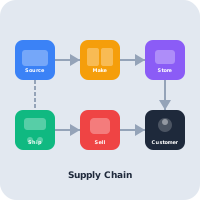
The problem
Most wholesalers extend credit on a salesperson’s judgement and find out who was over the limit when the cheque bounces.
Credit limits in someone’s head
A stockist two months behind still gets the next delivery.
Stock promised twice
Two warehouses, one spreadsheet, and an order fulfilled from a figure that was already gone.
Margin lost on imports
Freight and duty sit in an expense account, so the price list is built on the wrong cost.
How AWRA solves it
What Wholesale & Trade Distribution teams get.
An invoice that takes a customer past their credit limit is created on credit hold, and it cannot be edited or fulfilled until someone overrides it with a written reason that stays on the record.
Measure exposure the way a credit controller does — opening balance plus every unpaid invoice plus the new one — rather than the invoice on its own.
Take stock out of the warehouse when an approved invoice is fulfilled, not when it is drafted.
Watch receivables age by customer beside the stock they were sold, so credit and cover are decided on one screen.
Cost imported lines at landed value, with freight, duty and clearing allocated across the receipt.
Compare suppliers on on-time rate, lead-time variance and price drift computed from their real order history.
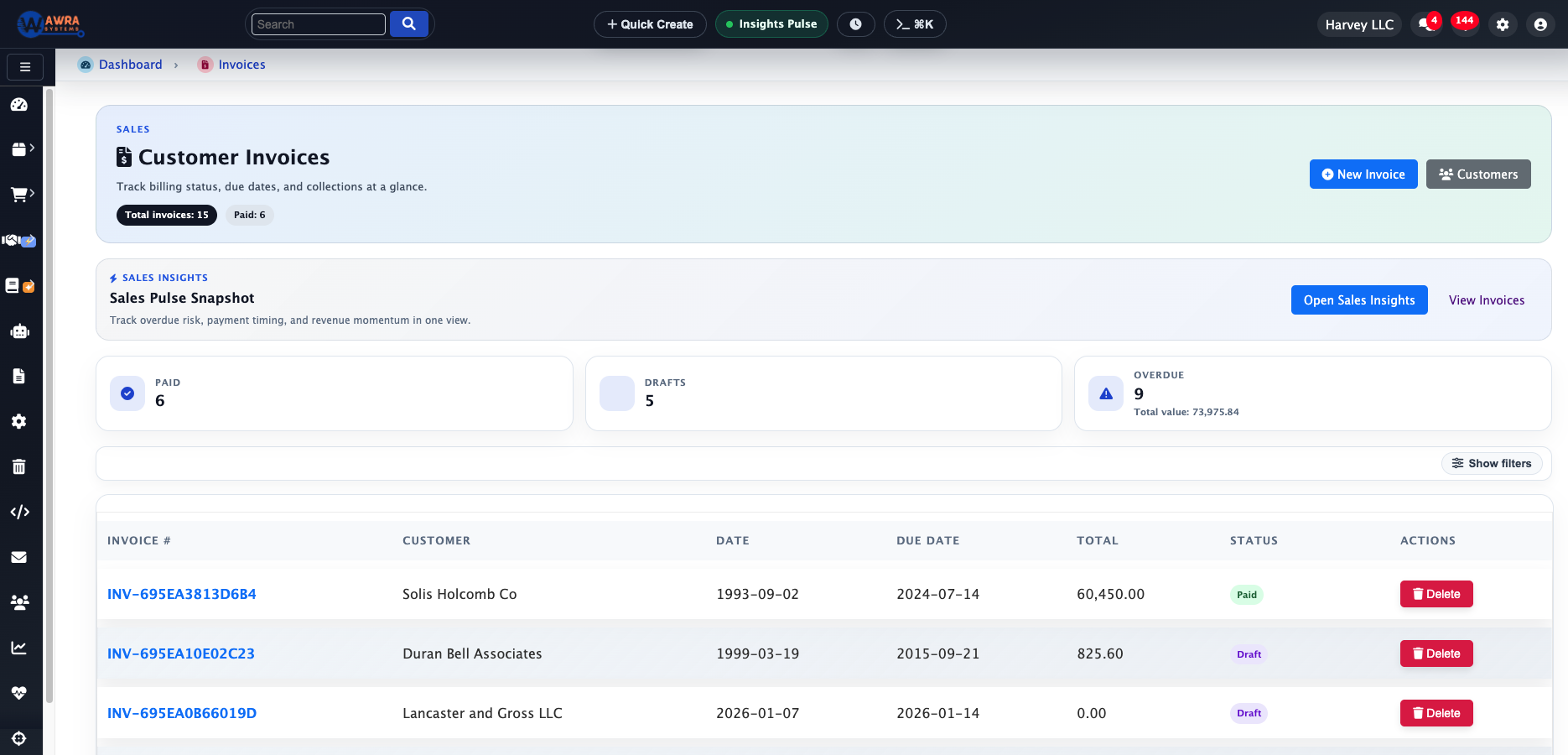
Account invoicing
Invoices with the customer’s credit position checked before they move.
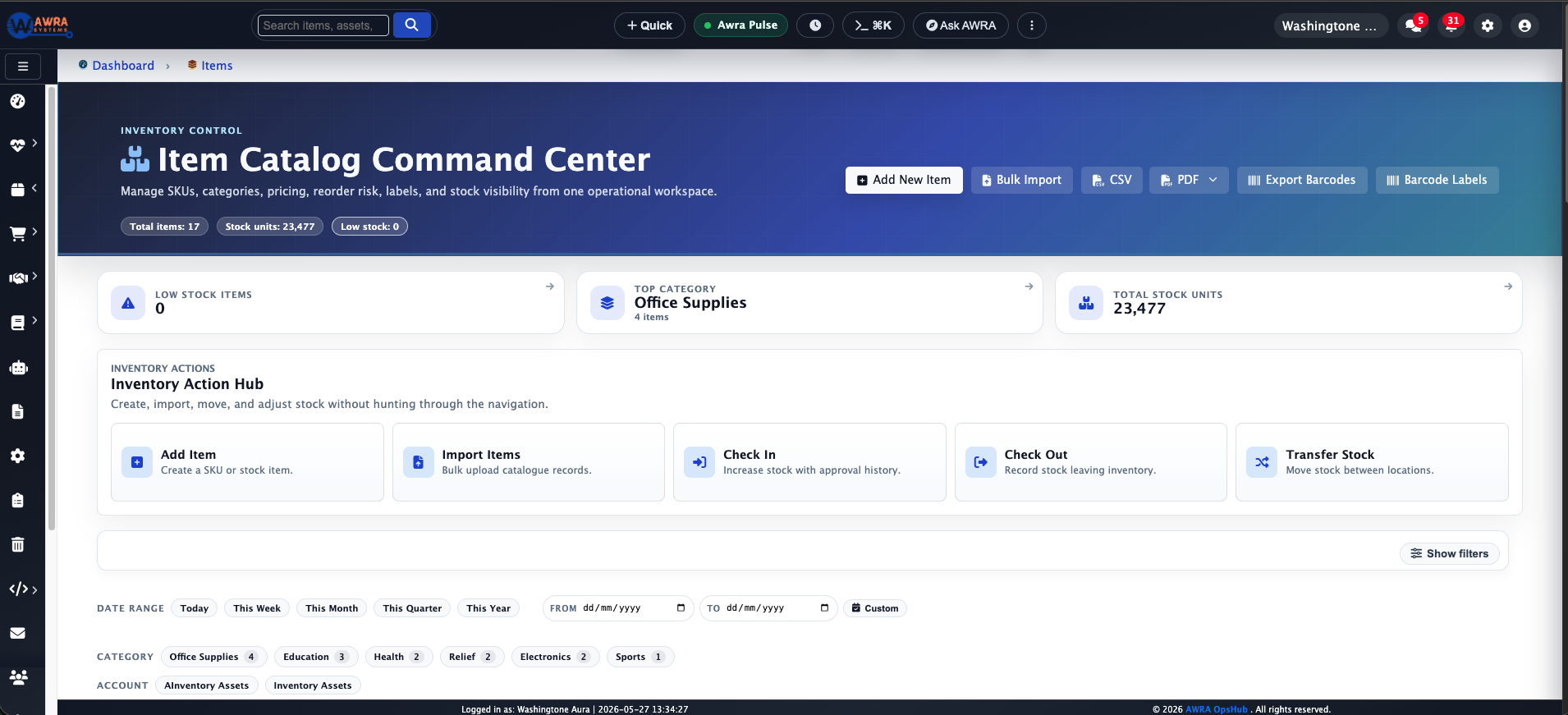
Multi-warehouse stock
Availability by item and warehouse, with reorder exposure.
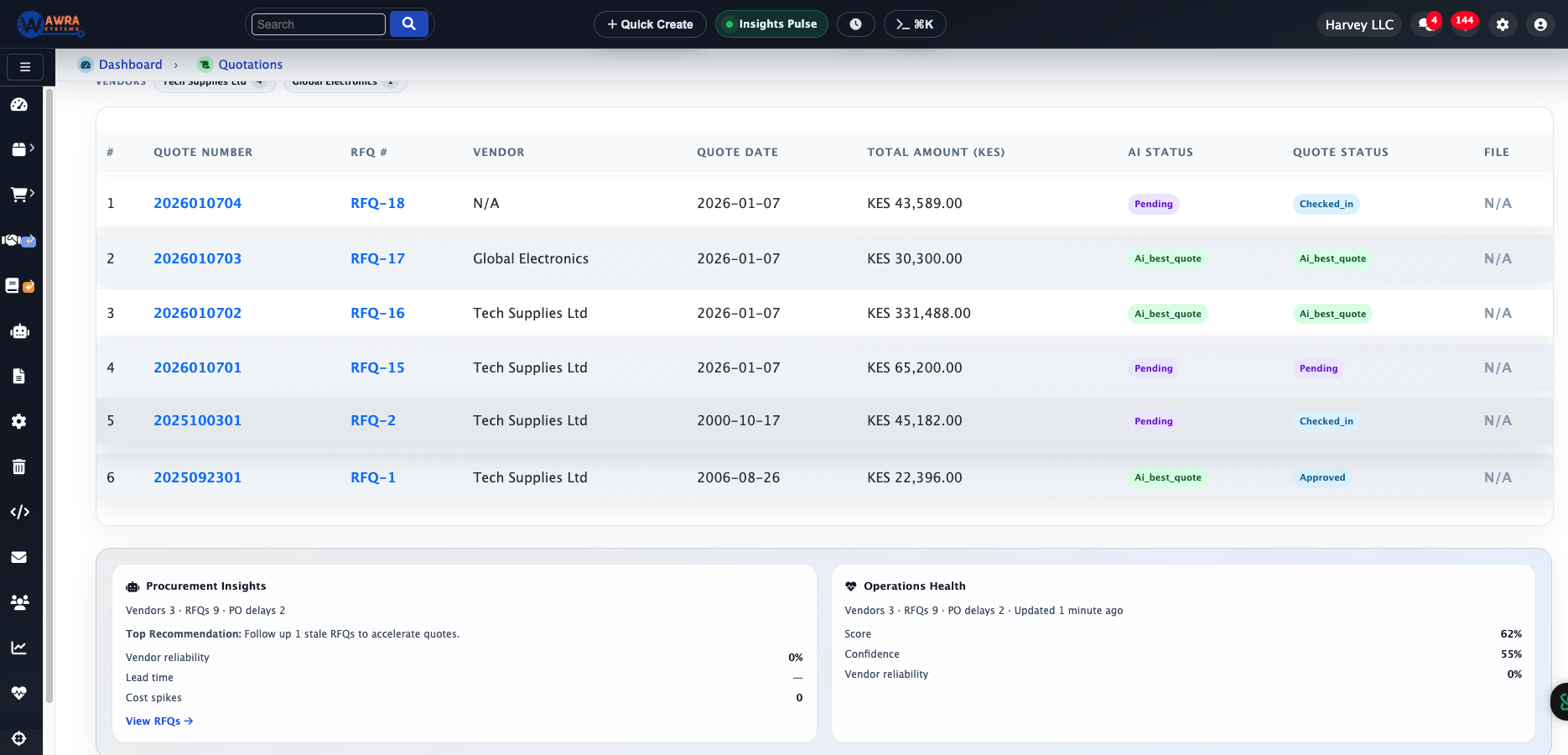
Supplier signals
Lead time, delivery reliability and price drift by vendor.
Typical workflow
The routines AWRA runs for Wholesale & Trade Distribution.
Credit-checked order
- 1 Raise the invoice for the account customer
- 2 Hold it automatically if the limit is passed
- 3 Override with a reason or collect first
- 4 Approve and fulfil from the warehouse
Warehouse balancing
- 1 Identify surplus and shortage by warehouse
- 2 Raise a transfer request
- 3 Dispatch and track in transit
- 4 Receive and close the variance
Collections review
- 1 Open receivables aging by customer
- 2 Send reminders on overdue balances
- 3 Review limits for repeat holds
- 4 Match receipts to open invoices
Modules used
What a wholesale & trade distribution workspace runs on.
invoice billing Account invoicing with an enforced credit hold See the module aging reports Receivables aged by customer See the module Stock Transfers & Approvals Balancing stock between warehouses See the module Landed Costs Freight, duty and clearing carried into stock cost See the module
Example organisation
A two-warehouse general wholesaler
An illustrative profile, not a named customer
Where they are today
Two warehouses, about 120 account customers on credit, imported and local lines, and credit limits kept on a printed list.
Where they would start
They would start by importing the item list and setting credit limits on every account customer, then raise all new invoices in AWRA from one warehouse.
What changes after implementation
Before and after, in the routines you already run.
| Before | After |
|---|---|
| Credit checked by asking the accountant | An over-limit invoice held until someone overrides it with a reason |
| Stock deducted when someone remembers | Stock taken out when the approved invoice is fulfilled |
| Import costs in an expense account | Landed cost allocated across the receipt |
| Debtors reviewed at month-end | Receivables aged by customer as they fall due |
How the rollout goes
1
Set credit limits on account customers before go-live. A customer with no limit is never held, which is the right default for a cash buyer and the wrong one for a stockist.
2
Each item carries one selling price, with a discount per line on the invoice, and stock is held in one unit in whole numbers. Price lists or customer tiers, and carton-to-piece conversion, are commissionable work rather than settings today — so stock each line in the unit you sell most.
3
Releasing a credit hold uses the same permission that approves invoices, so decide who holds it. A separate credit-controller permission is commissionable on a written specification.
What you can measure afterwards
Credit holds raised
Receivables aging
Stock cover days
Landed cost variance
Transfer cycle time
Pricing
What it costs for Wholesale & Trade Distribution
Inventory, transfers and customer invoicing with credit hold start on Basic. Receivables aging and landed-cost allocation are on Pro.
Pro plan · Run on automation
KES 5,800 / month
or KES 63,800 billed yearly
Full procurement, sales, accounting and HR (employees, leave, attendance & payroll) plus workflow automation and reporting.
Before you pay anything
30-day free trial
Thirty days of the full platform, every module switched on and no card required. Choose a paid tier whenever you are ready.
See it on your process
Walk through a wholesale & trade distribution workspace with us.
Bring the spreadsheet or the paper form you want to retire. We will show you the first workflow in AWRA with your own items, people and locations.
Questions
What Wholesale & Trade Distribution buyers ask.
What happens when a customer goes over their credit limit?
The invoice is created on credit hold. It cannot be edited or fulfilled until someone with invoice permissions overrides it with a written reason, and the override records who, when and why.
Can different customers get different prices?
Each item carries one selling price, and an invoice line can carry a discount. Price lists and customer tiers are commissionable work rather than a setting today.
Can we sell by the carton and by the piece?
Not as a conversion on one item today. An item has one unit and whole-number quantities, so stock each line in the unit you sell most.
Customer story
Speak to someone who runs it.
We publish a named story only with that organisation’s consent. Ask us and we will put you in touch with a wholesale & trade distribution reference you can telephone, rather than a quote you cannot check.
Ask for a referenceNext-best links
Keep the evaluation moving.
Guides, pricing and support surfaces most relevant to Wholesale & Trade Distribution.
Related industries
Compare adjacent operating models.
Retail
AWRA OpsHub connects POS, stock movement, replenishment, cash sessions, and branch reporting for retail operators.

Healthcare
Healthcare teams use AWRA to monitor critical consumables, control purchasing, receive supplies, and report availability by location.
FMCG Distribution
AWRA helps FMCG distributors manage item velocity, warehouse stock, vendor lead times, branch replenishment, and sales performance.
Help Center
Need a quick answer while you read?
Run inventory, procurement, assets, sales, and field work with approved AWRA guidance for setup, migration, integrations, security, pricing, and support.