
Ask AwraIQ about features, pricing, onboarding, login, integrations, security, demos, mobile apps, automation, reports, or support.
All industry pages
High-volume movement
Move fast-moving goods with better replenishment discipline.
AWRA helps FMCG distributors manage item velocity, warehouse stock, vendor lead times, branch replenishment, and sales performance.
Inventory software for FMCG distributors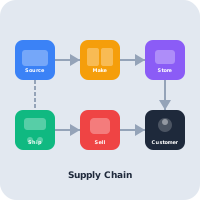
The problem
Fast-moving goods punish slow information. By the time the weekly stock sheet arrives, the fast lines have already run out at one depot and piled up at another.
Stock cover nobody can see
Days of cover per SKU per depot is a calculation someone does when there is time.
Transfers lost in transit
Stock leaves one warehouse and is not received at the other for days, with no in-transit figure.
Landed cost guessed
Freight and duty arrive weeks after the goods and never reach the unit cost.
How AWRA solves it
What FMCG Distribution teams get.
Depot and customer queries become tickets with a priority, an owner and an SLA, and the overdue ones escalate rather than age quietly.
See delayed supplier orders and unpaid invoices side by side in the Control Tower, so cash and cover are one conversation.
Balance warehouse availability against fast-changing demand.
Improve vendor planning with lead-time and fulfillment visibility.
Use sales and inventory signals to reduce emergency replenishment.
Watch receivables age by distributor beside the stock they were given, so credit and cover are decided on one screen.
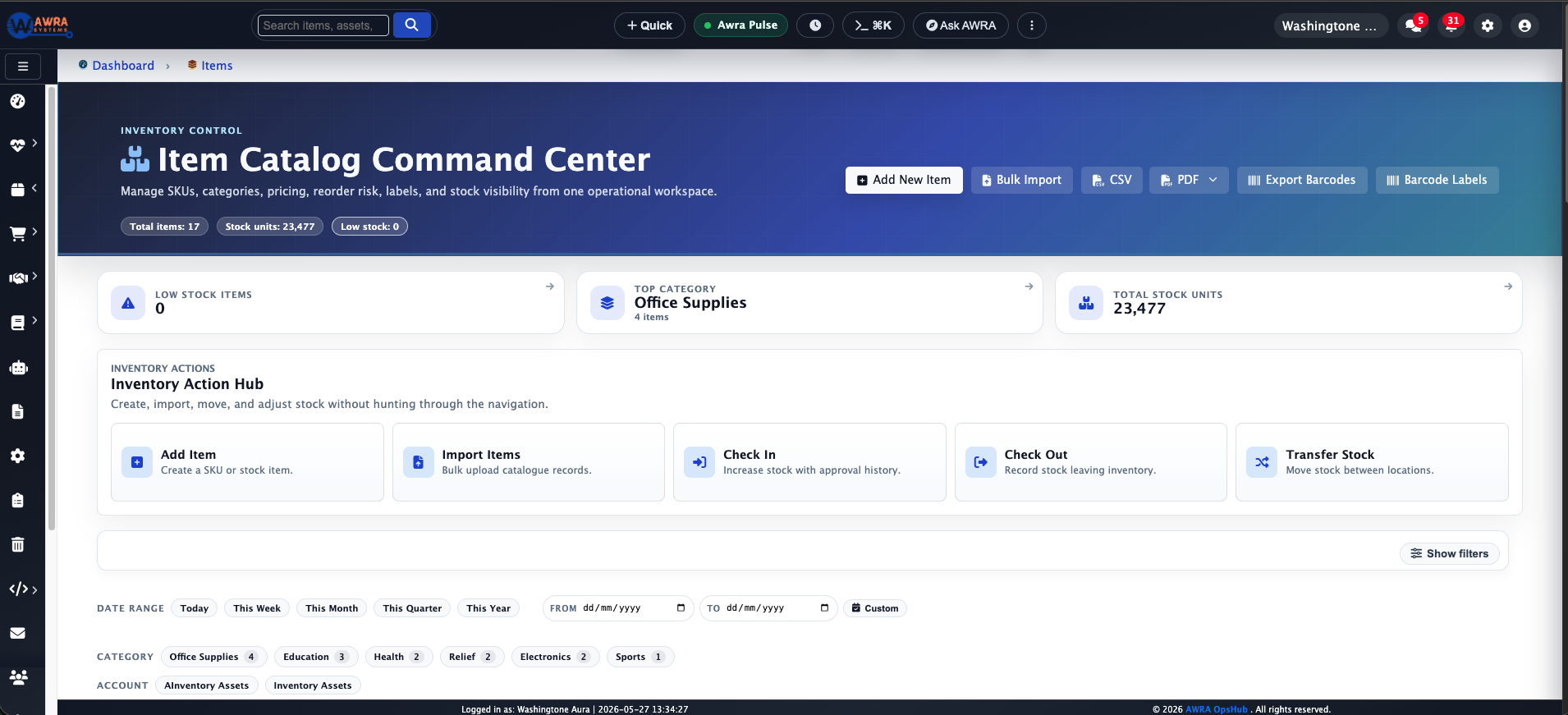
Multi-warehouse stock
Review availability, committed stock, and reorder exposure.
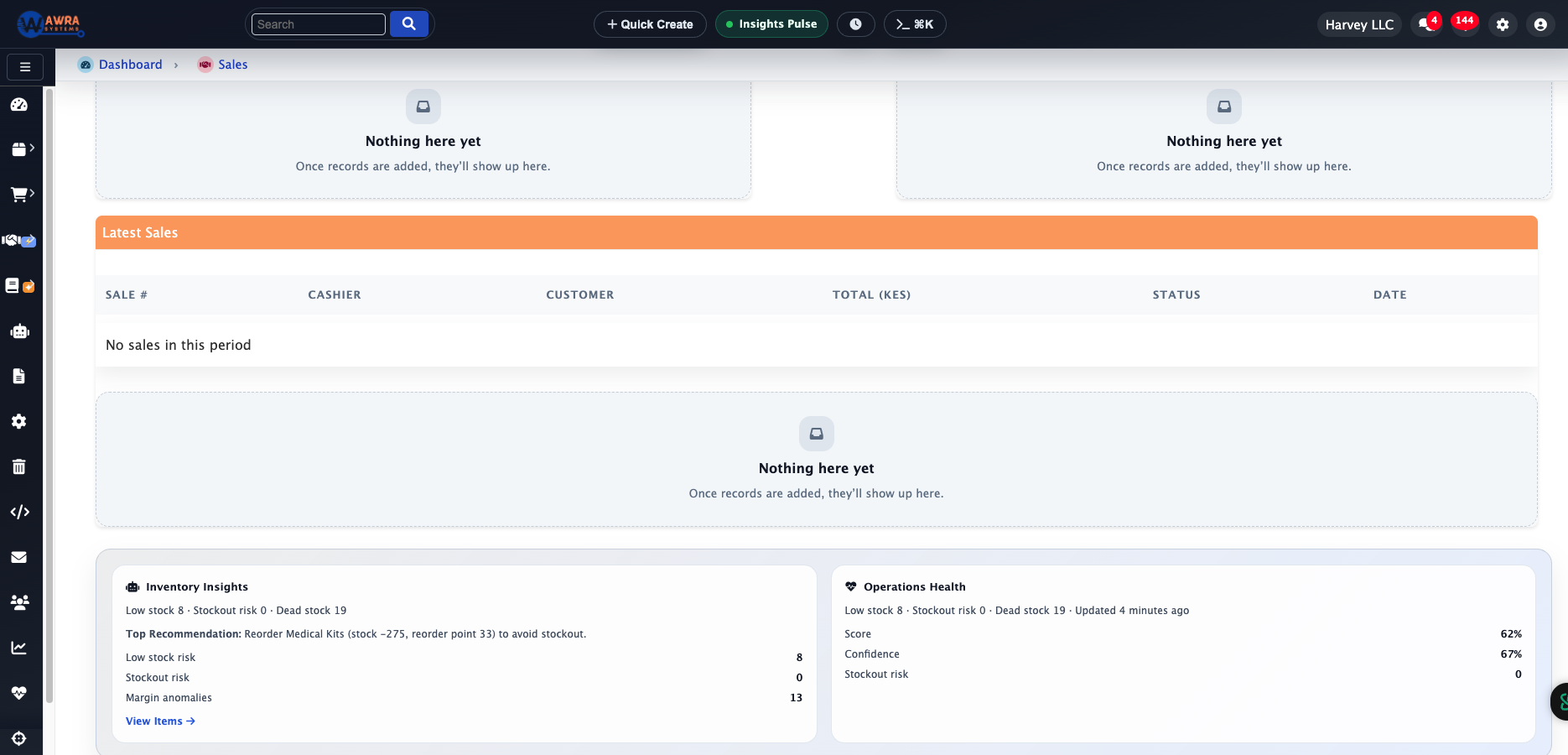
Sales velocity
See which items and branches are driving movement.
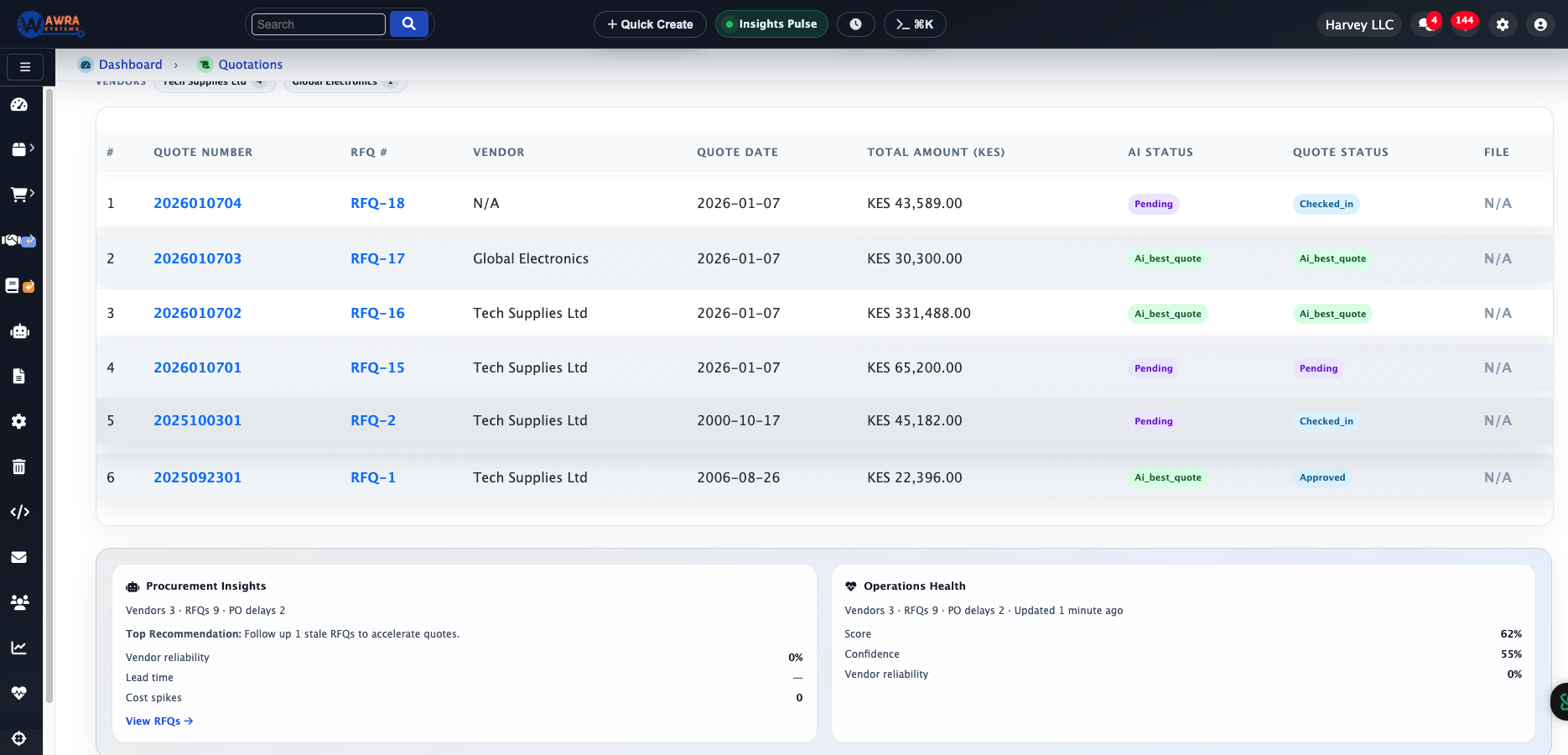
Procurement signals
Track vendor response and replenishment performance.
Typical workflow
The routines AWRA runs for FMCG Distribution.
Velocity-led replenishment
- 1 Review top moving SKUs
- 2 Compare current stock and demand trend
- 3 Approve purchase or transfer suggestions
- 4 Monitor supplier delivery
Warehouse balancing
- 1 Identify excess and shortage locations
- 2 Create transfer request
- 3 Dispatch stock to in transit
- 4 Receive and close variance
Vendor performance review
- 1 Measure response time
- 2 Compare landed cost
- 3 Review fulfillment reliability
- 4 Adjust preferred supplier lists
Modules used
What a fmcg distribution workspace runs on.
Inventory Management Velocity and stock cover per SKU and location See the module Stock Transfers & Approvals Depot balancing with stock tracked in transit See the module Landed Costs Freight and duty carried into the unit cost See the module Sales Insights Sales velocity and margin by line and branch See the module
Example organisation
A regional beverages distributor
An illustrative profile, not a named customer
Where they are today
Three depots, 600 SKUs, a sales team in the field, and stock positions compiled by hand each Friday.
Where they would start
They would start with the item list and a count at each depot, then move inter-depot transfers onto AWRA before purchasing.
What changes after implementation
Before and after, in the routines you already run.
| Before | After |
|---|---|
| Stock compiled by hand on Friday | Stock by depot, current with every movement |
| Transfers with no in-transit figure | Transfers dispatched, tracked in transit and received |
| Landed cost estimated | Freight, duty and clearing allocated into the cost |
| Supplier reliability by reputation | Lead time and fulfilment measured per supplier |
How the rollout goes
1
Import item master data with units, pack sizes, reorder rules, warehouses, and vendor mappings.
2
Pilot replenishment rules on high-volume SKUs before applying them to the full catalog.
3
Use procurement analytics and sales reports together to separate demand issues from supplier issues.
What you can measure afterwards
Stock cover days
Sales velocity
Lead-time variance
Transfer cycle time
Landed cost variance
Pricing
What it costs for FMCG Distribution
Inventory and transfers are fully on Basic. Landed-cost allocation and full procurement are on Pro.
Pro plan · Run on automation
KES 5,800 / month
or KES 63,800 billed yearly
Full procurement, sales, accounting and HR (employees, leave, attendance & payroll) plus workflow automation and reporting.
Before you pay anything
30-day free trial
Thirty days of the full platform, every module switched on and no card required. Choose a paid tier whenever you are ready.
See it on your process
Walk through a fmcg distribution workspace with us.
Bring the spreadsheet or the paper form you want to retire. We will show you the first workflow in AWRA with your own items, people and locations.
Questions
What FMCG Distribution buyers ask.
Can we see stock in transit between depots?
Yes. A transfer moves through dispatch and receipt, so stock that has left one depot and not reached the next is visible as in transit.
Does AWRA calculate landed cost?
Yes. Freight, duty and clearing can be allocated by value or quantity, and a landed-cost document stays open after receipt so costs invoiced later still reach the unit cost.
Can field sales staff work on the phone?
The mobile app covers stock movements, transfers, counts and POS sales, and queues them offline when the signal drops.
How do we start?
Import the item list, count each depot, and move transfers first. Purchasing and landed cost follow once the depot balances are trusted.
Customer story
Speak to someone who runs it.
We publish a named story only with that organisation’s consent. Ask us and we will put you in touch with a fmcg distribution reference you can telephone, rather than a quote you cannot check.
Ask for a referenceNext-best links
Keep the evaluation moving.
Guides, pricing and support surfaces most relevant to FMCG Distribution.
Related industries
Compare adjacent operating models.
Retail
AWRA OpsHub connects POS, stock movement, replenishment, cash sessions, and branch reporting for retail operators.
Healthcare
Healthcare teams use AWRA to monitor critical consumables, control purchasing, receive supplies, and report availability by location.
Logistics & Warehousing
Warehouse and logistics teams use AWRA for receiving, location control, transfers, cycle counts, scanner workflows, and approvals.
Help Center
Need a quick answer while you read?
Run inventory, procurement, assets, sales, and field work with approved AWRA guidance for setup, migration, integrations, security, pricing, and support.