
Helpdesk Software in Kenya: When Email and WhatsApp Stop Working
Support runs on email and WhatsApp until the day something important is lost, and then everybody agrees it should have been on a system months ago. The threshold, what a helpdesk actually has to do, and where ours stops.
Nobody buys helpdesk software because they wanted one. They buy it the week after a customer complaint sat unanswered in somebody's personal inbox while that person was on leave, or after a client asked how long their issue had been open and three people gave three different answers.
Until that week, email and WhatsApp genuinely work. They are fast, everyone already uses them, and a small team can hold the whole picture in their heads. The problem is not that those tools are bad — it is that they store requests in individual people rather than in the organization, so the organization cannot see, measure or guarantee anything.
The threshold, concretely
You have outgrown inbox support when any of these is true. Most Kenyan businesses cross two or three at once and only notice the consequence.
- More than one person handles requests. The moment two people share the work, "who has this?" becomes a question nobody can answer without asking.
- Somebody's absence blocks a request. If a colleague going on leave means their open issues stop moving, those issues were never with the business.
- You have promised a response time. A commitment you cannot measure is not a commitment, it is a hope you have shared with a customer.
- The same question arrives repeatedly and each person answers it from scratch, differently.
- Somebody asks for numbers. How many issues last month, how long did they take, what caused them — all unanswerable from a set of inboxes.
- A request has been genuinely lost and you only found out because the customer followed up. This is the one that usually triggers the purchase.
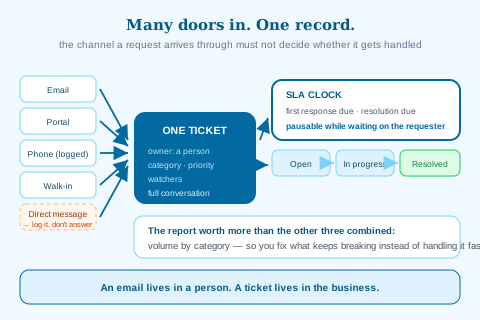
An email lives in a person. A ticket lives in the business. Everything a helpdesk gives you follows from that one difference.
What a helpdesk has to do
Strip the feature lists and there are five requirements. Everything else is refinement.
-
Capture from every channel into one queue
Email, a portal, a walk-in logged by reception, a phone call. If some channels bypass the system, the queue is not the truth and people will keep working around it.
-
Give every ticket an owner
Not a team — a person, at all times. "The support team is looking at it" is how issues sit for a week. Assignment can change; being unassigned should be a visible exception.
-
Categorise and prioritise at intake
Category drives routing and, later, the analysis of what keeps breaking. Priority drives the clock. Both are cheap at intake and impossible to reconstruct afterwards.
-
Start a clock you can defend
First-response and resolution targets carried by the category — and the ability to pause when you are genuinely waiting on the customer. See SLAs that mean something.
-
Keep the whole conversation on the ticket
Every reply, internal note and attachment. A ticket that requires reading somebody's inbox to understand is not a record.
Internal support is the bigger opportunity
Most people hear "helpdesk" and think customer support. In Kenyan organizations the larger unmanaged volume is usually internal: a branch whose printer is down, a finance request for a system permission, a facilities issue at a site, an IT problem that arrives as a phone call to whoever answered last time.
Internal requests are almost never tracked, which makes them invisible in every direction — nobody can say how much time IT actually spends, which sites generate the most problems, or whether the person who handles everything is drowning. It is also the easiest place to start, because your colleagues will tolerate a new process while you refine it in a way that customers will not. That case is made in the internal helpdesk.
Where ours stops
What AWRA OpsHub does today
- Tickets with categories, priorities, owners and watchers, and the full conversation held on the ticket.
- An SLA engine — first-response and resolution targets carried per ticket category, genuinely pausable while you wait on the requester, with breach notification.
- Intake portals, including a tokenized route for people who have no login.
- Comments, internal notes and attachments on every ticket.
- An agent dashboard and queues, so workload is visible rather than assumed.
- Slack notification where your team already works.
- Reporting on volume, category and resolution time, from live tickets.
More we can add to your workspace
- A live chat widget for your public website.
- A public knowledge base you can publish to customers as self-service articles.
- Social-media inbox management. Twitter/X, Facebook and Instagram direct messages arriving as tickets, on the pattern the email and chat channels already follow.
- Customer-satisfaction surveying or NPS after resolution.
Where we point you to a specialist
- We are not a call centre platform. Telephony, IVR, call recording and routing belong in one, and we would rather point you at one than approximate it.
If your support is predominantly phone-based or you need a website chat widget, treat this as the ticketing and SLA layer and pair it with a channel tool rather than expecting one product to do both.
Anything above that you need, we can build for you
Everything listed above as something we can add describes what ships in the standard product today — it is a starting point, not a limit on what AWRA OpsHub can do for your organisation. Kenya's eTIMS integration and its maintained payroll engine are both in the product because clients needed them and commissioned them; neither appeared by itself, and the same door is open for whatever you just read about. One qualification so this is worth what it claims: a small number of things on this blog we deliberately leave to a specialist rather than build — a statutory ledger we will not sign our name to, a rule that would decide a tax question for you, a clinical or member-funds record that belongs in a regulated system — and where that is true the post says so in those words. Everything else is a scope, a timeline and a price.
The operational work, which is what most commissions actually are
An extra approval stage in a chain that does not match the standard one, a custom field set on employees or assets that only your sector needs, an expiry that has to block an order rather than send an email, a report your board asks for in a shape nothing produces, or a scanner or weighbridge feeding the goods-in door. These are the commissions we are asked for most often and the smallest ones we quote — and unlike a revenue-authority pipeline, none of them waits on a regulator.
The module-shaped additions, which are the ones readers ask for most often
A price list with real discount authority, a customer-facing quotation that expires, a bill of materials or recipe costing, a staff advance that is issued, acquitted and chased, a member or unit ledger, a matching rule that holds a payment. Each of these is a build rather than a setting, and each has been quoted before — a bigger piece of work than a custom field, with a written spec and a date instead of a roadmap slide.
The report, document or pack nothing currently produces
The board pack in the shape your board actually asks for, a donor or funder layout, an invoice or receipt template carrying what your regulator or your customer expects, a dataset the report builder cannot reach yet. Usually the fastest thing on this list to deliver, because the data is already in the system.
Systems, rails and hardware you already run
The accounting package, CRM, online store, core banking or custom database you intend to keep — connected through our API so a fact is entered once and appears everywhere it is needed. Plus the physical edge: a scanner, a scale, a weighbridge or a till peripheral feeding the door it belongs to.
How it works: you describe the requirement, we return a written scope, timeline and cost, and once agreed it is built into your environment and maintained as part of the product. Nothing here waits on a regulator or a published specification, which is why operational builds are the ones we quote fastest. Tell us the requirement that would otherwise rule us out — that is a better first conversation than a demo.
Tell us what your operation needsThe mistake that kills helpdesk rollouts
It is always the same one: leaving a channel open that bypasses the system. Requests keep arriving directly to a favourite colleague, that colleague keeps handling them because refusing feels obstructive, and within a month the helpdesk contains a minority of the actual work — at which point every report from it is wrong and people conclude the system does not reflect reality.
The fix is a rule with one polite sentence behind it: anything not in the system is not a request. The colleague who receives a direct message logs it as a ticket rather than answering it. That takes about three weeks to become normal and it is the difference between a helpdesk and a second place where some support happens.
Log it, do not refuse it
The rule is not "stop messaging me" — that reads as bureaucracy and fails. It is "I will log this so it does not get lost." Same outcome, no friction with the requester, and the record exists. Most successful rollouts we have seen are exactly this sentence, repeated for a month.
What to measure once it runs
Four numbers, and they change what you do rather than merely describing it.
| Number | What it tells you | What to do with it |
|---|---|---|
| Volume by category | What actually keeps breaking | Fix the cause, not the tickets — this is the highest-value report |
| First response time | Whether requests are being acknowledged | Most dissatisfaction is silence, not slowness |
| Resolution time by category | Whether your promises are real, per kind of issue | Adjust the promise or the staffing; do not adjust the report |
| Reopened tickets | Where "resolved" means "closed" | A high reopen rate is a quality signal, not a customer problem |
The first row is worth more than the other three combined. A helpdesk that tells you the same category generates thirty tickets a month lets you stop generating them, which is a different kind of improvement from handling them faster. The reporting side is covered in operational dashboards.
Our take
Start with internal IT and facilities requests rather than customer support — lower stakes, more forgiving users, and usually more unmeasured volume. Close every side channel by logging rather than refusing. Then read volume by category monthly and fix causes instead of getting faster at symptoms.
See requests that cannot get lost
Tickets with owners and categories, an SLA clock you can pause, intake portals for people without logins, and reporting on what keeps breaking.
Explore AWRA HelpdeskFrequently asked questions
When is a business too small for a helpdesk?
While one person handles every request and nothing breaks when they are away, email is genuinely fine and adding a system is overhead. The threshold is the second person, because that is when "who has this?" stops being answerable without asking. In practice most organizations cross the line well before they act on it, and the trigger is usually a lost request they only heard about because the customer followed up.
Can it handle internal IT and facilities requests as well as customer issues?
Yes, and internal is usually where we would start. Internal requests are almost never tracked anywhere, which makes IT and facilities workload invisible, and colleagues tolerate a new process while you refine it in a way customers will not. Categories keep internal and external work separable in reporting while running on one queue and one SLA engine.
Does it include live chat or a knowledge base?
No to both. There is no website chat widget and no public knowledge base for customer self-service, and we would rather say so plainly than let you discover it after committing. What exists is ticketing, an SLA engine, intake portals including a no-login route, agent queues and reporting. If a chat widget or published help articles are essential, pair us with a tool that does that rather than expecting one product to cover both.
What about phone support?
There is no telephony — no IVR, no call routing, no recording. A call is logged as a ticket by whoever takes it, which is how most Kenyan SMEs handle it in practice, but if your support is predominantly phone-based you need a call platform alongside this. Treat us as the record and SLA layer rather than the channel.
How do we stop people bypassing the system?
By logging rather than refusing. The rule that works is not "stop messaging me" — that reads as bureaucracy and gets resented — it is "I will log this so it does not get lost." The person who receives a direct request creates the ticket instead of answering it directly. It takes roughly three weeks to become habit, and it is the single thing that determines whether your helpdesk reflects reality or contains a minority of the actual work.
